
Raleigh, NC · Wake County
Hardwood Floor Refinishing in Raleigh, NC
From century-old red oak in Five Points and Hayes Barton to wide-plank white oak in Wakefield Plantation and North Hills. Raleigh has the most diverse hardwood market in the Triangle. We assess every floor individually. Water popping on every stained job. Bona Certified Craftsman. HEPA dust containment. Five-year workmanship warranty.
Raleigh Hardwood Market
What We See in Raleigh Homes
Raleigh spans more than a century of residential construction, and no two neighborhoods are the same flooring job. Five Points, Oakwood, and Hayes Barton have original red oak floors that are 80 to 120 years old, some of the most character-rich floors in the Triangle, requiring careful wear-layer assessment before any sanding recommendation. Oversanding a thin historic floor is irreversible.
Cameron Village bungalows from the late 1940s and early 1950s typically have original red and white oak. Many have been refinished once or twice. Whether there is enough wear layer for another cycle is the first question on every job.
Midtown, Stonehenge, and Harps Mill homes from the 1980s and 1990s have red oak floors finished with oil-modified polyurethane that has yellowed heavily. These transformations, removing the orange cast and replacing it with a clean water-based finish in a modern stain, are some of the most dramatic work we do.
Wakefield Plantation, North Hills, Brier Creek, and the Falls of Neuse corridor lean toward white oak and engineered hardwood on slab, often in the first refinish cycle. These floors respond well to stain color changes using water popping for deep, even absorption.
Neighborhoods We Serve
- Five Points
- Oakwood
- Hayes Barton
- Cameron Village
- North Hills
- Brier Creek
- Wakefield Plantation
- Falls of Neuse
- Stonehenge
- Harps Mill
- Midtown
- Downtown Raleigh
- Quail Hollow
- Crabtree
- Inner Beltline
- Bedford at Falls River
The Bona PowerDrive Difference
We own and run a Bona PowerDrive planetary sander on every refinish. The planetary head moves in a circular orbital pattern that removes less material per pass than a drum sander and reaches within 1.5 inches of walls without a separate edger. For Five Points and Hayes Barton floors where the remaining wear layer is the top concern, the PowerDrive may unlock one or two additional refinish cycles that a drum sander would not. We own ours.
How We Work
Our Refinishing Process, Step by Step
Every Raleigh job follows the same structured sequence from first visit to final walkthrough. No shortcuts, no skipped steps, whether you are in Five Points or Wakefield Plantation.
In-Home Assessment
We measure the space, assess the wear layer remaining on your floors with a physical gauge, evaluate board stability, and identify any moisture issues. Historic-neighborhood floors receive extra scrutiny. You leave the meeting with a written estimate, a specific day-by-day timeline, and honest answers about what is and is not possible.
Prep and Dust Containment Setup
Furniture is removed from the work area. We hang doorway plastic, connect cyclonic dust separators to the sanders, run HEPA filtration vacuums, and place air scrubbers with external filters on your HVAC returns. All of this happens before the first sander starts.
Sanding
We use the Bona PowerDrive planetary sander for the main field and the Lagler Flip for edges and corners. The PowerDrive removes less material per pass than a drum sander and reaches within 1.5 inches of walls, critical on older Raleigh floors where every millimeter of wear layer matters. Multiple grits produce a flat, consistent surface ready for finish.
Water Popping Before Color
If the job includes stain, we water pop the bare sanded wood before color goes down. Lightly misting the floor opens the wood grain and allows stain to absorb more deeply and evenly. Skipping it produces visibly uneven results. We then apply sample colors directly on your floor, in your actual lighting, so you see exactly how each stain reads before committing to the full surface.
Stain and Sealer
Stain is applied in long, even passes and worked into the grain. After drying, a sealer coat locks the stain and prepares the surface for finish. The sealer coat is lightly screened before finish coats begin. This sequence ensures proper adhesion through every layer.
Finish Coats
We apply a sealer coat and two finish coats, lightly screening between each. We work exclusively with water-based systems. Bona Traffic HD, Bona Mega, and Rubio Monocoat hardwax oil. No oil-modified polyurethane. Water-based finishes have lower VOCs, cure faster, and perform better long-term on the species common to Raleigh homes.
Cure Time and Re-Entry
Water-based finishes allow socks on the floor 4 hours after the final coat. Bona Traffic HD reaches full cure in 3 days; Bona Mega One in 5 days. During the cure period we recommend no area rugs, furniture pads rather than bare furniture legs, and avoiding heavy traffic. We provide written care instructions.
Final Walkthrough and Warranty
We inspect the finished floor with you before we leave. We do not close out a job until you are satisfied with the result. Every refinishing project is backed by a five-year workmanship warranty from the day the job is complete.
Dust Containment
Three-Stage Dust Containment on Every Job
Floor sanding produces fine wood dust that spreads throughout a home if not actively contained. We run a three-stage system that captures the dust at the source, filters the air moving through the work area, and prevents recirculation through your HVAC system. We run all three on every job.
The result is a working environment that stays manageable during the job and a home that requires minimal cleanup when we leave. Raleigh homeowners who have had floors refinished before consistently notice the difference.
We use Festool equipment throughout. Festool HEPA vacuums and cyclonic separators are purpose-built for fine wood dust. The filters are checked and cleaned between jobs so they perform at rated efficiency on your floor, not someone else's.
Stage 1
Cyclonic Dust Separator at the Sander
A cyclonic separator sits between the sander and the vacuum. Centrifugal force spins heavy dust particles into a collection container before they reach the vacuum filter. This extends HEPA filter life and ensures maximum suction at the sander head throughout the job, not just at the start before filters load up.
Stage 2
HEPA Filtration Vacuums
Festool HEPA vacuums with true HEPA filters capture particles down to 0.3 microns at 99.97% efficiency. Fine wood dust, the kind that stays airborne longest and penetrates furthest, is captured at this stage before it can move beyond the immediate work area.
Stage 3
Air Scrubbers on HVAC Returns
Air scrubbers are placed at your HVAC return vents to filter any dust that escapes the first two stages before it can enter the duct system. Without this step, fine dust circulates through the entire home via forced air. This is the stage we never skip.
Finish Systems
Finish Options for Raleigh Homes
We work exclusively with water-based and hardwax oil finish systems. No oil-modified polyurethane. Every finish we carry dries faster, has lower VOCs, and performs better long-term than the oil-based finishes that dominate the budget end of the Raleigh market. Full finish comparison guide →
Catalyzed Hardwax Oil
Rubio Monocoat
Single-coat penetrating oil that bonds at a molecular level. Produces an open-grained look that feels like the wood rather than a coating over it. Small scratches and worn areas can be spot-treated without resanding the entire floor. Ideal for homes with dogs or children.
Catalyzed Hardwax Oil
Natura OneCoat
Our other go-to penetrating oil system alongside Rubio Monocoat. Same single-coat application, same spot-repairability, same Zero VOC rating. We recommend based on the specific color and sheen combination that best matches your floor.
Water-Based Polyurethane
Bona Traffic HD
Our most-specified finish for Raleigh homes. Commercial-grade durability in a residential product. The hardest water-based finish we carry. Holds up to heavy dog traffic better than residential-grade alternatives.
Water-Based Polyurethane
Bona Mega One
Flexible residential-grade water-based finish. Softer than Traffic HD, a good choice for rooms with less foot traffic where maximum hardness is not the priority.
A note on oil-based polyurethane: We do not apply oil-modified polyurethane. Oil-modified finishes take 24+ hours between coats, off-gas heavily for days, require 2–4 weeks to fully cure, and yellow significantly over time, the heavy amber cast on original Raleigh hardwood from the 1980s and 1990s is almost always the result of oil-modified polyurethane aging. Bona Traffic HD reaches full cure in 3 days. Our hardwax oils are usable in 5 days. All of our finishes start clearer, stay clearer, and return your home to normal far sooner.
Pet-Friendly Floors
Dog-Friendly Hardwood Floors in Raleigh
The honest answer is that no hardwood floor finish is scratch-proof for dogs. The real question is which combination of species, stain, sheen, and finish system makes scratches least visible and easiest to repair when they do appear. We put the whole recipe together in our guide to the best hardwood floor finish for dogs.
Species matters more than finish. Harder species resist surface scratching better than softer ones. White oak (Janka hardness 1360) is harder than red oak (1290), which is harder than pine (870). Hickory (1820) is significantly harder than all three. If you are installing new floors and have dogs, species choice is the first lever to pull. Our Janka hardness guide covers the full scale.
Sheen matters almost as much as species. Scratches on a matte or satin finish are nearly invisible. The same scratch on a semi-gloss or gloss finish catches light and shows clearly. Most Raleigh homeowners with dogs choose matte or satin for this reason alone.
Among finish systems, Rubio Monocoat is our recommendation for dog households because of its spot-repairability. Small scratches and worn areas can be treated with Monocoat directly on the damaged area without resanding the surrounding floor. This means a dog household floor stays presentable between refinishing cycles rather than accumulating visible wear.
Dog-Friendly Recommendations
Best species for dogs.
White oak, hickory, and Brazilian cherry resist surface scratching better than red oak, pine, or cherry. If you are installing new floors, start here.
Best sheen for dogs.
Matte or satin. Scratches hide in low-sheen surfaces. Semi-gloss and gloss amplify every mark. Most of our dog-household clients choose Bona Traffic HD in matte or satin.
Best finish for dogs.
Rubio Monocoat for its spot-repairability. Bona Traffic HD for maximum hardness. Both work, the right choice depends on how important spot repair is versus maximum initial scratch resistance.
Practical tips.
Keep nails trimmed. Place rugs at exterior doors where dogs enter wet. Use felt pads under all furniture. Recoat every 3 to 5 years to maintain the finish layer before wear-through reaches the wood.
We discuss your household, dogs, children, traffic levels, how often you want to maintain, at the in-home assessment and give you a specific recommendation based on your situation, not a generic answer.
Transformations
Before and After: Raleigh Refinishing Projects
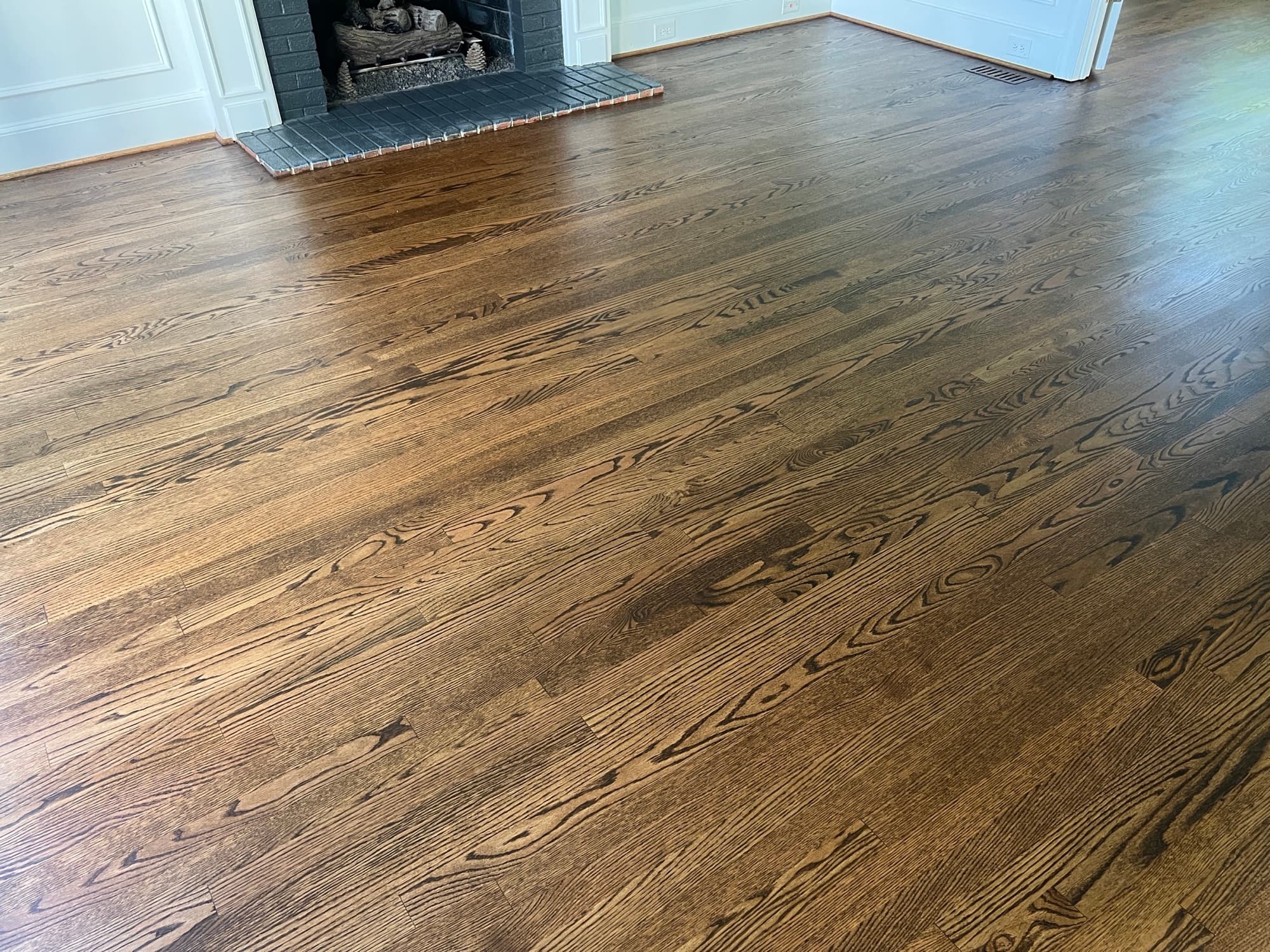
Umstead Ridge · Raleigh, NC
Red Oak Installation + Seamless Blend Match
The Problem
The family room had carpet over particle board and the kitchen had vinyl over luan. Both had to be demolished before a board could go in. The harder problem: matching new red oak to the aged, patinated hardwood in the rest of the house. New wood reads completely different from wood that has lived in a home. Getting new and old to read as one floor required precise sanding sequence, water popping, and stain application timing.
The Solution
New 2.25" red oak installed. The full new installation plus the existing hardwood was sanded as one continuous surface with the Lagler Hummel. Water popping before stain opened the grain evenly across both old and new wood. DuraSeal Quick Dry Stain in Medium Brown, finished with Natura OneCoat Hardwax Oil. Standing anywhere in the house, you cannot tell where the new floor starts.
See Full Project →Turner Downs · Raleigh, NC
Red Oak with Aged Barrel + Rubio White Oil Ceruse
The Challenge
The homeowners wanted a cerused look, a floor where there is visual contrast between the hard and soft grain of the wood. This is usually achieved by rubbing white into raw wood. This job went further: stain first to establish a warm amber base, then Rubio Monocoat White Oil applied over the dried stain to deposit white pigment specifically into the soft grain channels. The result is a two-toned floor with genuine depth.
The Technique
4" red oak installed over Bona R540 moisture barrier. Full-house sanded as one continuous surface after installation. Water popping throughout, then DuraSeal Aged Barrel as the base stain. Rubio Monocoat 5% White Oil applied over dried stain, the white pigment settled into the soft grain channels while the hard grain held the Aged Barrel warmth. The contrast between the two tones is the ceruse.
See Full Project →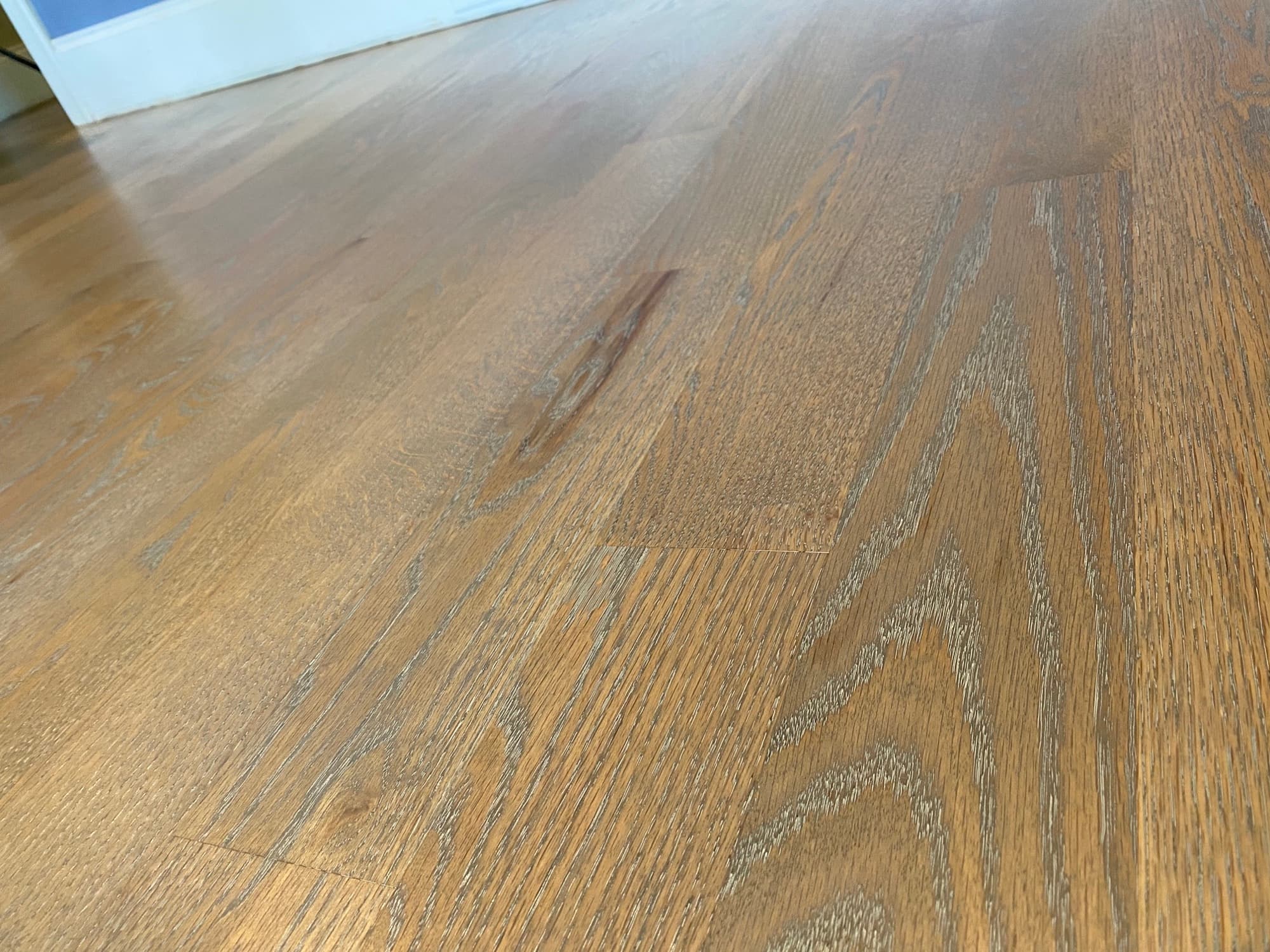
Water Damage Repair + Refinishing · Raleigh, NC
The Transformation: Orange 1990s Red Oak → Clean Modern Finish
Before
Heavy oil-modified polyurethane with deep amber-orange cast
Worn-through finish on high-traffic kitchen-to-living room lane
Water damage at dishwasher, three boards buckled and stained
Squeaks throughout the dining room subfloor
After
Full sand with Bona PowerDrive, orange cast removed completely
Buckled boards replaced with lace-in, color-blended to surrounding floor
Squeak source diagnosed and corrected from below
Water popping + DuraSeal Weathered Oak stain + Bona Traffic HD matte
Day by Day
What to Expect: Refinishing Timeline
A typical Raleigh refinishing project runs four to six working days. Here is what each day looks like and what you can and cannot do during the process.
In-Home Assessment
We measure, assess wear layer, discuss stain options on your actual floor, and deliver a written estimate with a day-by-day schedule.
Home Access
Normal access to your home throughout.
You Can
Everything. This is a planning visit.
Furniture Removal + Sanding Begins
We remove furniture, set up dust containment, and begin sanding. Main field with Bona PowerDrive. Edges and corners with Lagler Flip. First two grits completed.
Home Access
You may stay in the home. Keep children and pets out of the work area.
You Can
Other areas of the home are fully accessible.
Fine Sanding + Final Screen
Final sanding passes with fine grits bring the floor to a consistent, smooth surface ready for stain or finish. Floor is vacuumed and tacked before EOD.
Home Access
Same as Day 1. Work area is active with sanding.
You Can
Rest of home accessible. Limit cooking to minimize airborne particulates.
Water Pop + Stain Application (if staining)
Floor is misted to open the grain (water pop). Stain is applied in long even passes. Floor must dry completely before anyone walks on it, typically 4 to 6 hours.
Home Access
Stay off the stained floor entirely until dry.
You Can
Any area not being stained is accessible.
Sealer Coat
Sealer coat applied after stain dries completely. Sealer locks the stain and prepares the surface for finish coats. Screened lightly when dry.
Home Access
Stay off the sealed floor for 4 hours.
You Can
Other areas fully accessible.
Finish Coats 1 & 2
First finish coat applied in the morning. Lightly screened when dry. Second finish coat applied in the afternoon. Re-entry 4 hours after the second coat with socks only.
Home Access
Socks only on the finished floor. No shoes, no pets, no furniture.
You Can
Light kitchen and bathroom use is fine. Avoid dragging anything across the floor.
Final Walkthrough
Final walkthrough once the second finish coat has dried. Furniture can be replaced on felt pads after 24 hours. No area rugs for 3 to 5 days.
Home Access
Normal light use with socks. Furniture back in 24 hrs.
You Can
Normal life resumes with light precautions for 3 to 5 days.
Full Cure
Bona Traffic HD reaches full hardness in 3 days; Bona Mega One in 5 days. Until then, avoid dragging furniture, using area rugs, or cleaning with excess water.
Home Access
Normal use. Light precautions only.
You Can
Everything except rugs and dragging furniture.
Recoating timeline is shorter. A screen-and-recoat job, no sanding to bare wood, no stain change, is typically completed in a single day. Socks on the floor 4 hours after the final coat. Full cure in 3 days (Traffic HD) or 5 days (Mega One). Recoating costs significantly less than full refinishing and is the right choice when the floor is structurally sound with a dull finish and no stain change desired. Learn more about recoating →
Pricing
Hardwood Floor Refinishing Pricing in Raleigh
All pricing requires an in-home assessment. The ranges below reflect typical Raleigh projects. Written estimate before any work begins. $1,500 project minimum applies.
| Service | Starting Price | Typical Range | Timeline |
|---|---|---|---|
Recoating No bare wood sanding. Restores dull finish, keeps existing color. | $2.25/sqft | $2.25 – $3.00/sqft | 1 day |
Refinishing, No Stain Sand to bare wood, natural or clear finish. Keep existing color. | $5.50/sqft | $5.50 – $6.50/sqft | 4 – 6 days |
Refinishing, With Stain Sand to bare wood, water pop, custom stain color, finish. | $5.50/sqft | $5.50 – $8.00/sqft | 4 – 6 days |
What affects the final price
Floor Condition
Floors with deep pet staining, multiple old finish layers, significant repairs, or cupping require additional prep time that affects the per-square-foot price.
Species
Standard red oak and white oak are easiest to work with and carry the lowest price. Wide-plank, exotic, or historic species like heart pine require more care and time.
Stain Complexity
Custom stain blends, cerusing, or two-tone techniques take additional time and skill compared to a standard single-stain application.
Finish System
Rubio Monocoat and some European hardwax oils carry a higher material cost than standard Bona systems. This is reflected in the estimate.
Repairs Needed
Board replacement, lace-in repairs, and squeak elimination are separate line items in the estimate. We assess and price these during the in-home visit.
Square Footage
Smaller projects carry a $1,500 minimum. The per-square-foot price decreases on larger jobs where mobilization costs are spread across more area.
Prices shown are starting points for standard residential red or white oak in good condition. We provide complete written proposals after the in-home assessment. No hidden fees. No surprise line items. The price in the estimate is the price of the job.
Our Work
Refinishing Projects in Raleigh, NC
View All Projects →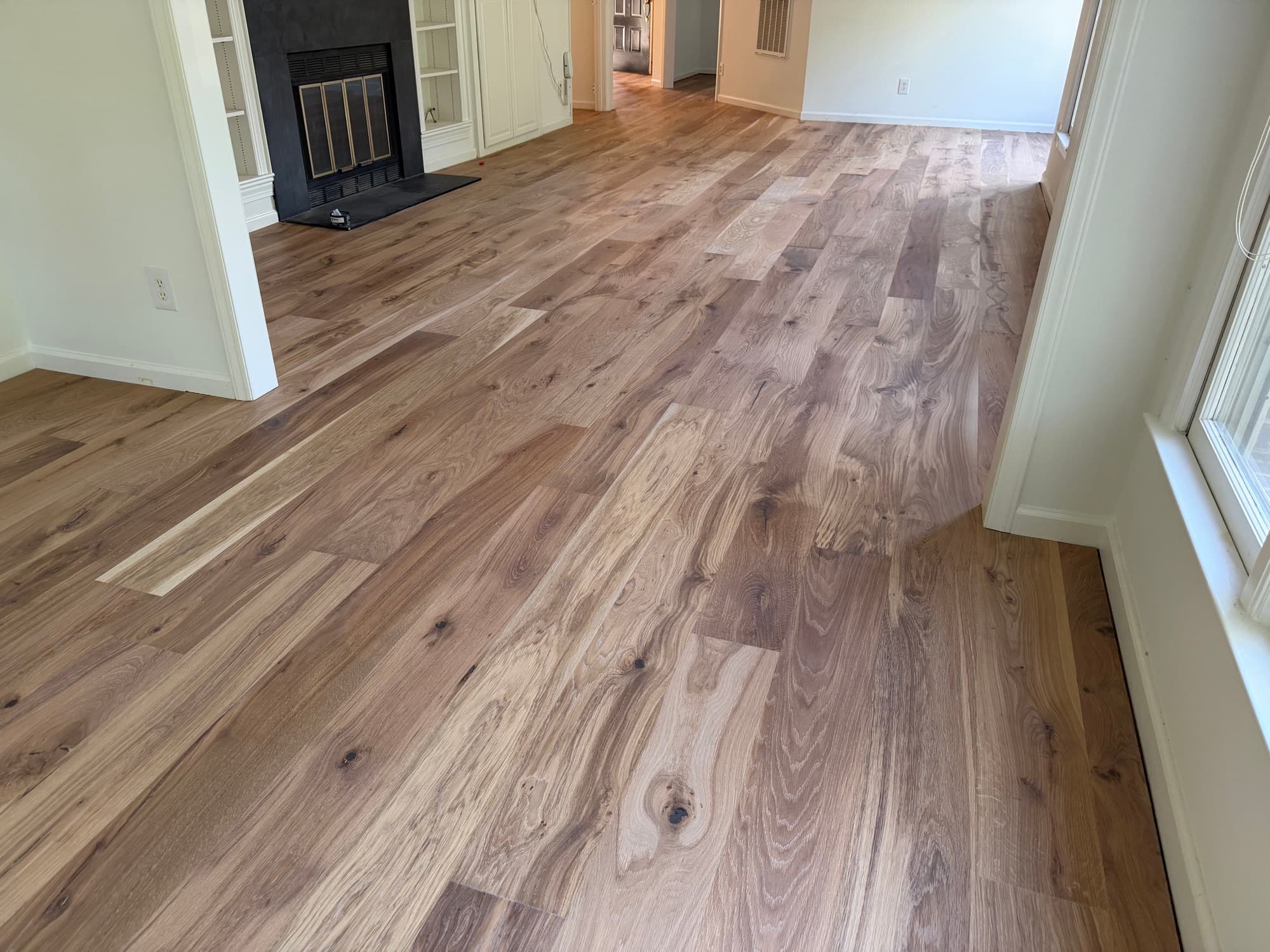
Hardwood Floor Installation · Off Glenwood Avenue, Downtown Raleigh
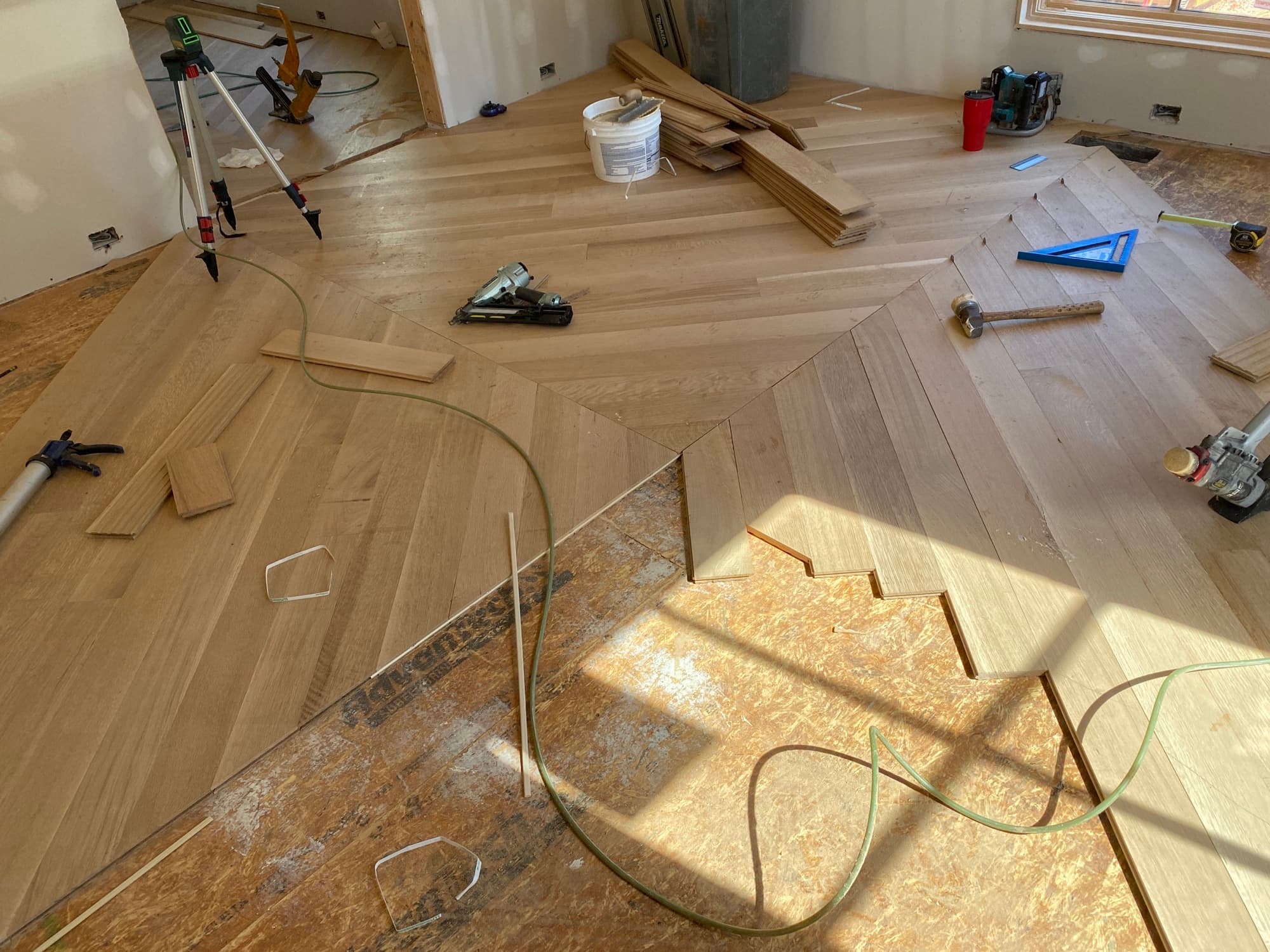
Character European White Oak Installation Off Glenwood Avenue in Downtown Raleigh, NC
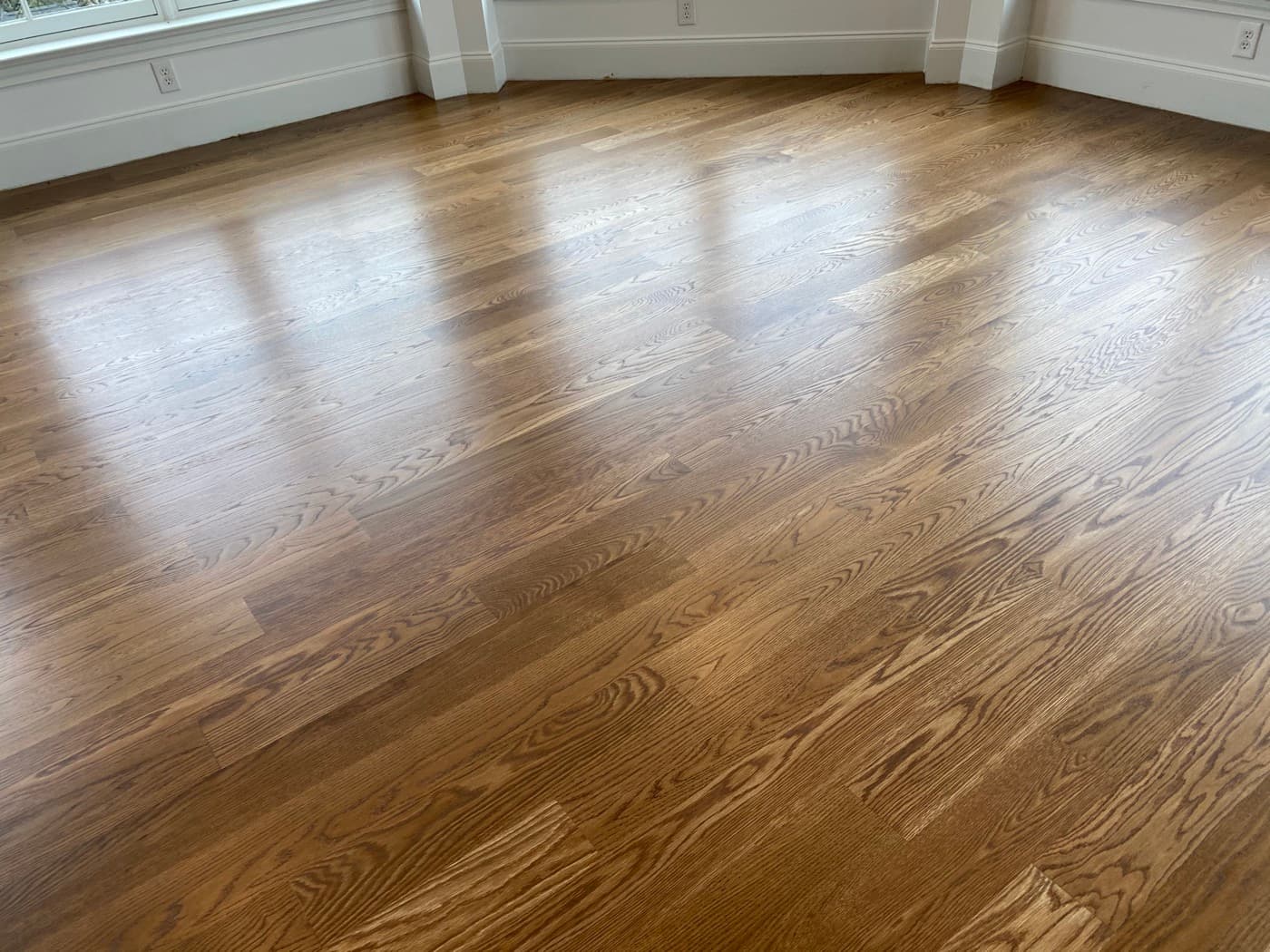
Engineered Hardwood Floor Installation · Bloomsbury Estates
Engineered White Oak Floor Installation in Bloomsbury Estates, Raleigh NC
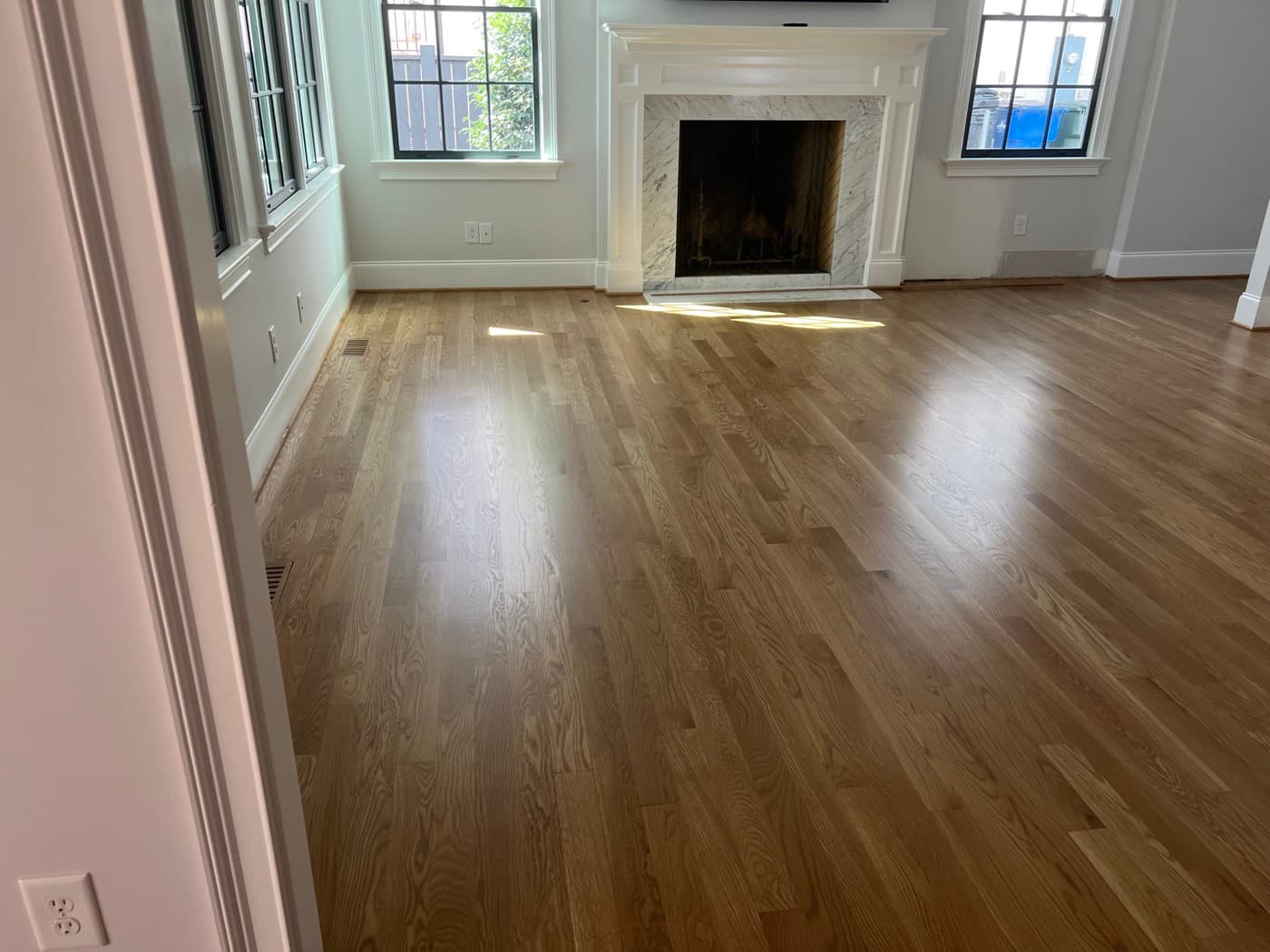
Hardwood Floor Rescue Refinishing and Board Repair · Hayes Barton
Rescue Refinish: Crowned Boards, Water Damage Repair, and Custom Weathered Oak Blend in Hayes Barton
Where We Work
Raleigh Neighborhoods We Serve
Five Points
c. 1900–1940 · Heart pine, original red oak
Some of the oldest floors in Raleigh. Wear layer assessment is the first conversation on every job here.
Oakwood
c. 1880–1940 · Original heart pine, red oak
Historic district. Victorian and craftsman homes with floors that reward careful, experienced refinishing.
Hayes Barton
c. 1920–1950 · Wide-plank original hardwood
Prestigious historic neighborhood with large homes. Often only refinished once. Premium work expected and delivered.
Cameron Village
c. 1945–1955 · Original red and white oak
Mid-century bungalows. Many approaching the limit of their sand life. Wear layer check required before commitment.
Midtown
Mixed · Original and renovated hardwood
Bridges older neighborhoods and newer development. Original hardwood in older homes, engineered in renovated builds.
North Hills
c. 1980s–2010s · Red oak, engineered white oak
Mixed residential and commercial corridor. Recoating and refinishing work throughout. First refinish cycles common.
Brier Creek
c. 2000–2015 · Engineered hardwood over slab
Fast-growing northwest Raleigh. Slab foundations are standard. Moisture management essential on every install.
Wakefield Plantation
c. 1998–2012 · Wide-plank white oak, engineered
Golf community with large homes. Species expertise and moisture testing are critical here.
Falls of Neuse
c. 1990–2005 · Site-finished hardwood
Established northeast Raleigh. Original site-finished hardwood entering first and second refinish cycles.
Stonehenge
c. 1985–2000 · Red oak with oil-modified finish
North Raleigh. Red oak floors with original oil-based finish. Transformation work is the most requested service here.
Harps Mill
c. 1990–2005 · Site-finished hardwood
Quiet north Raleigh community with custom homes. Refinishing and recoating on well-maintained floors.
Bedford at Falls River
c. 2002–2012 · Engineered over slab
Planned community on slab. Dual moisture testing standard on every job.
Quail Hollow
c. 1970–1990 · Red oak with original oil finish
West Raleigh. Heavily yellowed oil-based finish on original red oak. Transformation jobs are dramatic here.
Inner Beltline
c. 1920–1960 · Original hardwood
Dense neighborhoods inside I-440 including Boylan Heights and Glenwood-Brooklyn. Older hardwood that rewards skilled restoration.
Downtown Raleigh
Mixed · Engineered on concrete
Urban condos and renovated older homes. Engineered hardwood on concrete common. Careful moisture assessment before every install.
Crabtree
Mixed · Mixed hardwood and LVP
Central Raleigh area. Refinishing, recoating, and LVP installation all common depending on the home.
Reputation
What Our Customers Say
“My husband and I recently decided to redo our 23-year-old wood floors. I was hesitant as they seemed far beyond repair. The first night we went to look at the floors we were blown away. They look absolutely gorgeous -- better than the day they were installed.”
Kelli Linkous
“5 stars is not sufficient! Trust me, Izral is the absolute best. We recently renovated our home and had a horrible experience with another Raleigh company. After one consultation with Izral, I knew immediately he was the right person for the job.”
Ashley Jenkins
“Izral Daniels is a master of his craft. Superior product knowledge, attention to detail, and delivers what he promises. Excellent communicator, highly recommend. We could not be more pleased with our new hardwood floors.”
Ruthie Toler
Common Questions
Frequently Asked Questions
Refinishing in Raleigh typically ranges from $5.50 to $8.00 per square foot depending on floor condition, species, stain color, and finish system. Recoating starts at $2.25 per square foot. We carry a $1,500 project minimum. The range is meaningful here because Raleigh spans more than a century of construction, a Five Points bungalow with 100-year-old red oak is a different scope than a North Hills home with 2012 engineered white oak over slab. You receive a detailed written estimate after an in-home assessment with no hidden fees.
Most refinishing projects take four to six days: two days for sanding, half a day for staining if applicable, half a day for trim installation, and two days for finish coats and curing. Recoating is typically completed in a single day. With water-based finishes you can walk on the floor in socks 4 hours after the final coat. We provide a specific day-by-day timeline with your written estimate.
Water popping is lightly misting the bare sanded wood with water before stain goes down. The moisture temporarily opens the wood grain, allowing stain to absorb more deeply and evenly. The result is richer color, better coverage, and a more consistent finish across the full floor, especially important on red oak, which has pronounced grain variation. On older Five Points and Hayes Barton floors where the grain is highly varied, skipping water popping produces a blotchy, uneven stain. We use water popping on every floor that gets color, every time. It adds time and care to the job.
Yes, and this is work we take seriously. Historic neighborhoods have original red oak floors that are 80 to 120 years old. The wear layer on these floors is finite and cannot be oversanded. Before any sanding recommendation, we measure the remaining wear layer with a physical gauge, assess board stability, and evaluate previous finish layers. The Bona PowerDrive planetary sander removes less material per pass than a drum sander, making it the right tool for floors where every millimeter of wear layer matters. We assess every historic floor individually and tell you honestly if replacement is the better answer.
Refinishing means sanding the floor down to bare wood and starting fresh with stain and new finish coats. It corrects deep scratches, water damage, discoloration, and allows a complete color change. Recoating (screen-and-recoat) lightly abrades the existing finish surface and applies a fresh topcoat without sanding to bare wood. Recoating is faster, less expensive, and preserves the existing stain color. It is the right choice when the existing finish is dull but the wood underneath is undamaged and the current color is acceptable. We assess which option is correct during the in-home visit.
No finish is scratch-proof for dogs, the honest answer is that it takes a combination: a durable finish system, a low sheen, and a species that hides wear. Lower sheen levels (matte and satin) hide everyday scratches and scuffs much better than semi-gloss or gloss. Harder species like hickory and white oak resist denting, and busy grain hides the marks that softer or clean-faced species would show. Among finish systems, Bona Traffic HD is the most wear-resistant water-based finish we apply and the usual choice for heavy-use areas, while Rubio Monocoat oil finish allows spot repair of small scratches without resanding the entire floor. We discuss your specific situation and dogs at the in-home assessment.
Many customers stay in their homes during refinishing. We run a three-stage dust containment system including HEPA filtration vacuums at the sander, a cyclonic dust separator between the sander and the vacuum, and air scrubbers with external filters running on your HVAC returns. Water-based finishes have low VOCs and dry quickly, typically allowing you back on the floor in socks 4 hours after each coat. You will need to stay off the floor during sanding and keep pets and children away from the work area. We discuss your specific layout and situation at the assessment so you can plan accordingly.
The Bona PowerDrive is a gear-driven planetary sander we own and run on every refinish. Unlike a traditional drum sander which cuts material in one direction with high force, the PowerDrive moves in a circular planetary pattern that removes less material per pass, produces a flatter surface, and reaches within 1.5 inches of walls without a separate edger. For Raleigh homes with original hardwood approaching the end of their sand life, the PowerDrive may allow one or two additional refinish cycles that a drum sander would not. We own ours, it is not rented per job.
We work exclusively with water-based systems and European hardwax oils. Bona Traffic HD is our standard high-durability finish, commercial grade, available in Raw, Extra Matte, Satin, Semi-Gloss, and Gloss, and the most scratch-resistant water-based product we carry, with a 3-day full cure. Bona Mega One is a flexible residential-grade alternative with a 5-day full cure. Rubio Monocoat is a catalyzed hardwax oil requiring only one coat, producing a penetrating matte finish that feels open-grained rather than coated. It allows spot repairs without full resanding and is usable in 5 days. We do not apply oil-modified polyurethane, oil-based poly takes 2 to 4 weeks to fully cure, compared to 3 days for Bona Traffic HD.
The key variable is the remaining wear layer, the amount of solid wood above the tongue-and-groove joint. A floor with 3/4 inch solid hardwood can typically be sanded six to ten times over its lifetime depending on how aggressively each sand removes material. We measure the wear layer during the in-home assessment using a physical gauge at the edge of a vent or threshold. If the wear layer is insufficient, we tell you before any commitment is made. Signs that a floor may be approaching its limit: visible cupping that cannot be pressed flat, boards that feel hollow underfoot, or visible tongue showing along edges.
Yes. Any refinishing job that sands to bare wood gives you the ability to change stain color completely. We bring stain samples to your home and mix test colors directly on your actual floor so you see exactly how each reads in your specific lighting before committing. Going lighter is straightforward. Going darker is also achievable on most species. Red oak in particular is highly receptive to stain because of its open grain. We use water popping on every floor that gets color to maximize stain absorption and color consistency.
Most hardwood floors in Raleigh homes should be refinished every 10 to 15 years, or when the finish shows wear-through on high-traffic patterns. Recoating every 3 to 5 years extends the time between full refinishing cycles significantly. The goal is never to sand more than necessary. Each refinishing cycle removes a small amount of material from the wear layer. Fewer sands with proper maintenance means more cycles and more years of useful life from the floor. We assess the current condition at the in-home visit and recommend the minimum intervention that achieves your desired result.
Ready to Get Started?
Start With aFree Estimate
Serving Clayton, Garner, Raleigh, Cary, and communities throughout Johnston, Wake, and Durham Counties. We respond within one business day.
Ready to pick a time? Book your in-home assessment online →
After you request an assessment, we review your project details, confirm your location, and schedule an in-home visit. You will receive a written proposal with the scope, products, timeline, and warranty clearly explained.
Want to see our work first? Browse the portfolio →
More From 12th And Oak in Raleigh
Hardwood Floor Repair in Raleigh, NC
Board replacement, lace-in repairs, squeak elimination, and water damage repair. $1,000 minimum on repair-only work.
Hardwood Floor Installation in Raleigh, NC
Site-finished hardwood for Raleigh homes. Historic neighborhoods through new construction in Wakefield and North Hills.
LVP Flooring in Raleigh, NC
Luxury vinyl plank for Raleigh slab homes, basements, and below-grade spaces. Moisture tested on every job.
Staircase Remodeling in Raleigh, NC
Carpet-to-hardwood stair conversions with species and stain matching to your refinished floors.
Hardwood Floor Recoating
Screen-and-recoat for dull floors. Completed in a single day without sanding to bare wood. Lowest-cost restoration option.
Stain Color Gallery
Browse real projects organized by species and finish. Red oak, white oak, heart pine, custom blends.
All Raleigh Flooring Services
See every service we offer in Raleigh, NC, installation through custom floor vents.
Hardwood Floor Refinishing
Our full refinishing service page. Process, pricing, finish options, and how we work across the Triangle.
Portfolio
Browse 21 detailed case studies with before/during/after photos from Raleigh and Triangle projects.
Where We Work
Serving the Triangle Since 2002
Based in Clayton, NC. We travel throughout Johnston, Wake, and Durham Counties. Call to confirm your specific location.
Johnston County
Home Base- Clayton
- Garner
- Smithfield
- Selma
- Four Oaks
- Benson
- Kenly
- Princeton
Wake County
- Raleigh
- Garner
- Cary
- Apex
- Fuquay-Varina
- Holly Springs
- Wake Forest
- Knightdale
- Wendell
- Zebulon
Durham and Orange Counties
- Durham
- Chapel Hill
- Hillsborough
Don't see your city? Call us. We consider jobs outside these areas on a case-by-case basis, particularly for larger projects.
984-400-4OAK (4625)Get Started
Ready to Talk About Your Raleigh Floors?
Schedule an in-home assessment. We visit your home, measure the space, assess the wear layer, show stain samples on your actual floor, and give you a written estimate with a day-by-day timeline. No pressure, no commitment.
113 State Ave #103 · Clayton, NC 27520 · Serving all of Raleigh and Wake County