
Clayton, NC and the Triangle
Hardwood Floor Installation
Custom site-finished hardwood installed, sanded, stained, and finished completely on-site. Bona Certified Craftsman. Serving Clayton, Raleigh, Garner, Cary, Apex, and the Triangle since 2002.
Certifications, Accreditations and Industry Recognition










Price at a Glance
$15.00 to $25.00 per square foot, installed and finished
That is a turnkey price for new site-finished hardwood, with a $1,500 project minimum. Where you land in that range depends mostly on the wood you choose. Here is what it includes on every job.
- The hardwood, the installation, the sanding, and the finish in one price
- Moisture testing with two meters before the first board
- A roll-on moisture barrier under every installation
- Wood acclimated before it goes down
- A sealer coat and two coats of waterborne finish, or a hardwax oil system
- New shoe molding installed
- Carpet and pad removal on most projects
- A five-year workmanship warranty in writing
Removing other existing flooring, subfloor repair, and stairs are priced separately in your written proposal.
“Izral provided us with a detailed estimate and a thorough explanation of exactly how the job would be done.”
Want a ballpark first? Text photos, your city, and the approximate square footage and Izral will reply the same business day.
The Gold Standard
What Is Site-Finished Hardwood?
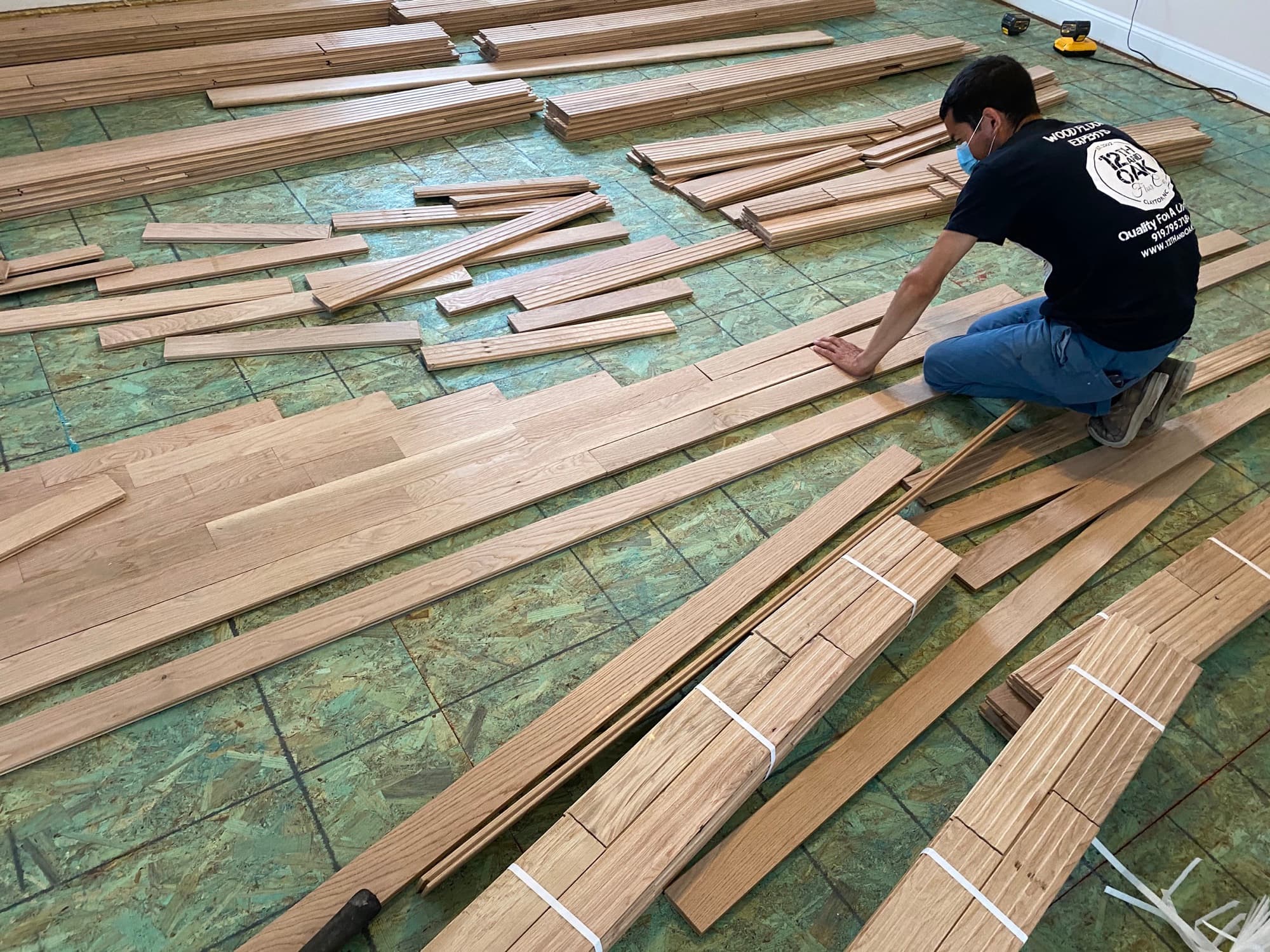
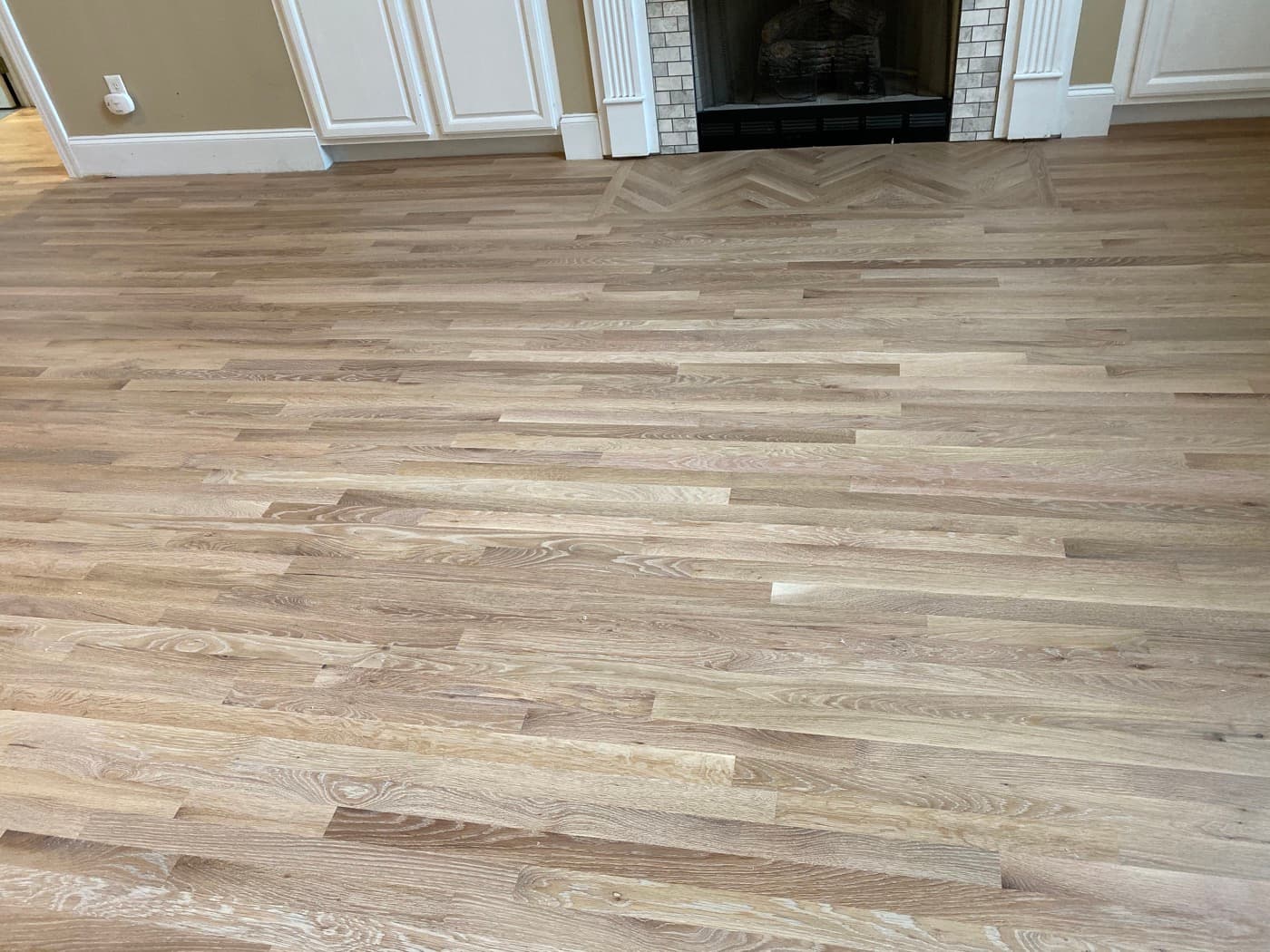
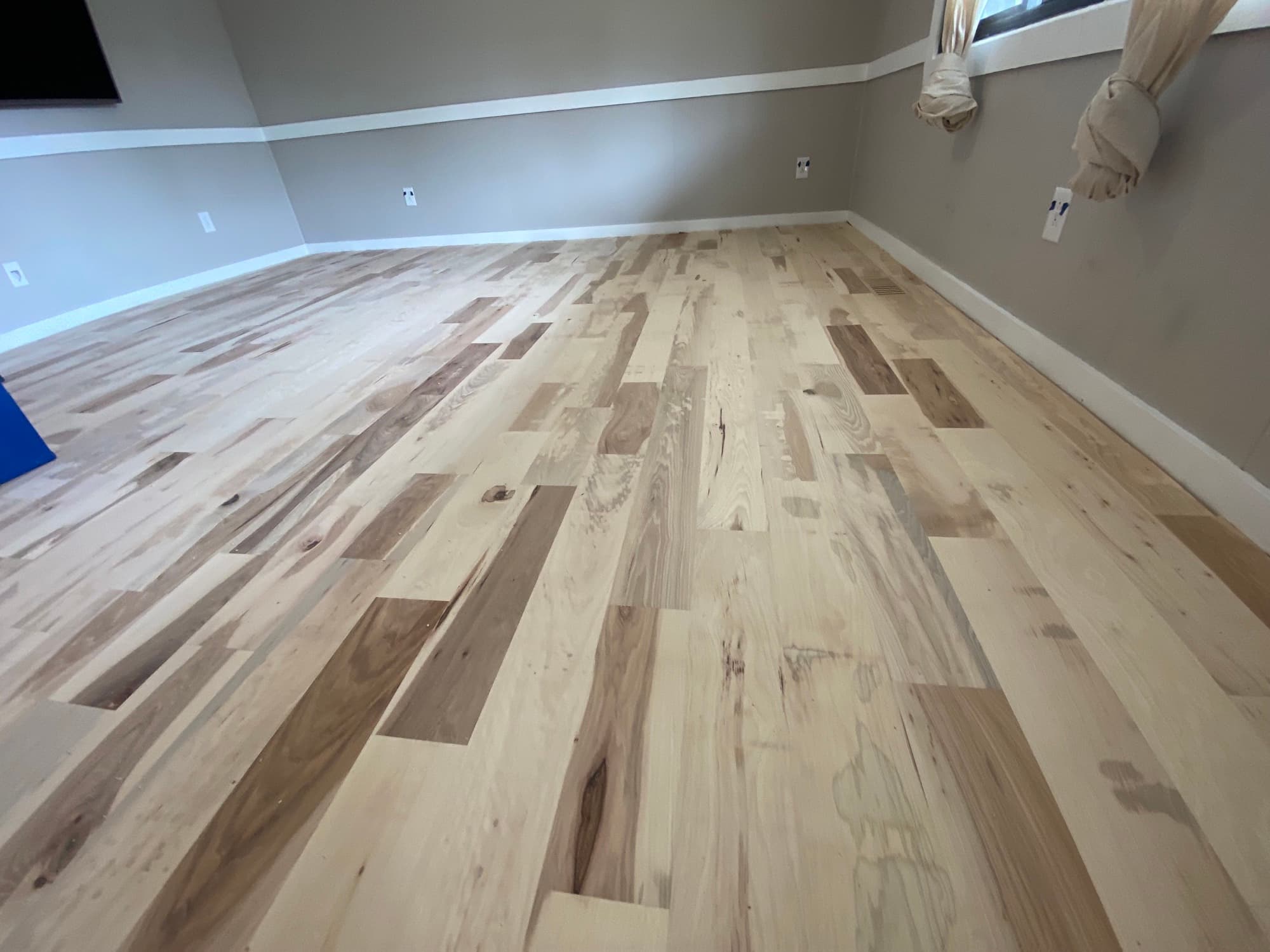
Site-finished hardwood is installed as raw unfinished wood and then sanded, stained, and finished in place inside your home. This is the gold standard of hardwood flooring installation and the only method we use at 12th And Oak Floor Co. Because the floor is finished in place, you also choose the color in place: stain samples are applied to your installed floor with the same sanding and water popping the final finish gets, so what you approve is what you get.
As a member of the National Wood Flooring Association (NWFA) since 2002, every installation we perform follows the industry's highest technical standards for subfloor preparation, acclimation, moisture testing, and finish application.
Not sure whether site-finished or prefinished is right for your project? Read the full comparison covering appearance, durability, finish bond, and when prefinished makes sense.
See Our Full ProcessSeamless results.
The entire floor is sanded and finished as one continuous surface, no seams, gaps, or inconsistencies between boards. Wall to wall uniformity.
Unlimited customization.
We custom blend colors on-site, testing and adjusting until we achieve exactly the right color for your wood species, your lighting, and your vision.
Better bond.
Finishing on-site allows the finish to penetrate into every gap and edge between boards, creating a stronger, more durable surface than factory-applied finishes.
Perfect for existing homes.
Site-finishing allows us to seamlessly blend new hardwood with existing floors, matching species, grain, and stain color for a result that looks like it was always there.
24 Years in the Triangle
What We See in Triangle Homes
The Triangle is not one market. Cary slab homes have different challenges than Johnston County crawlspace construction. Here is what 24 years of installations across this area has taught us.
Slab foundations in Cary, Apex, and Holly Springs.
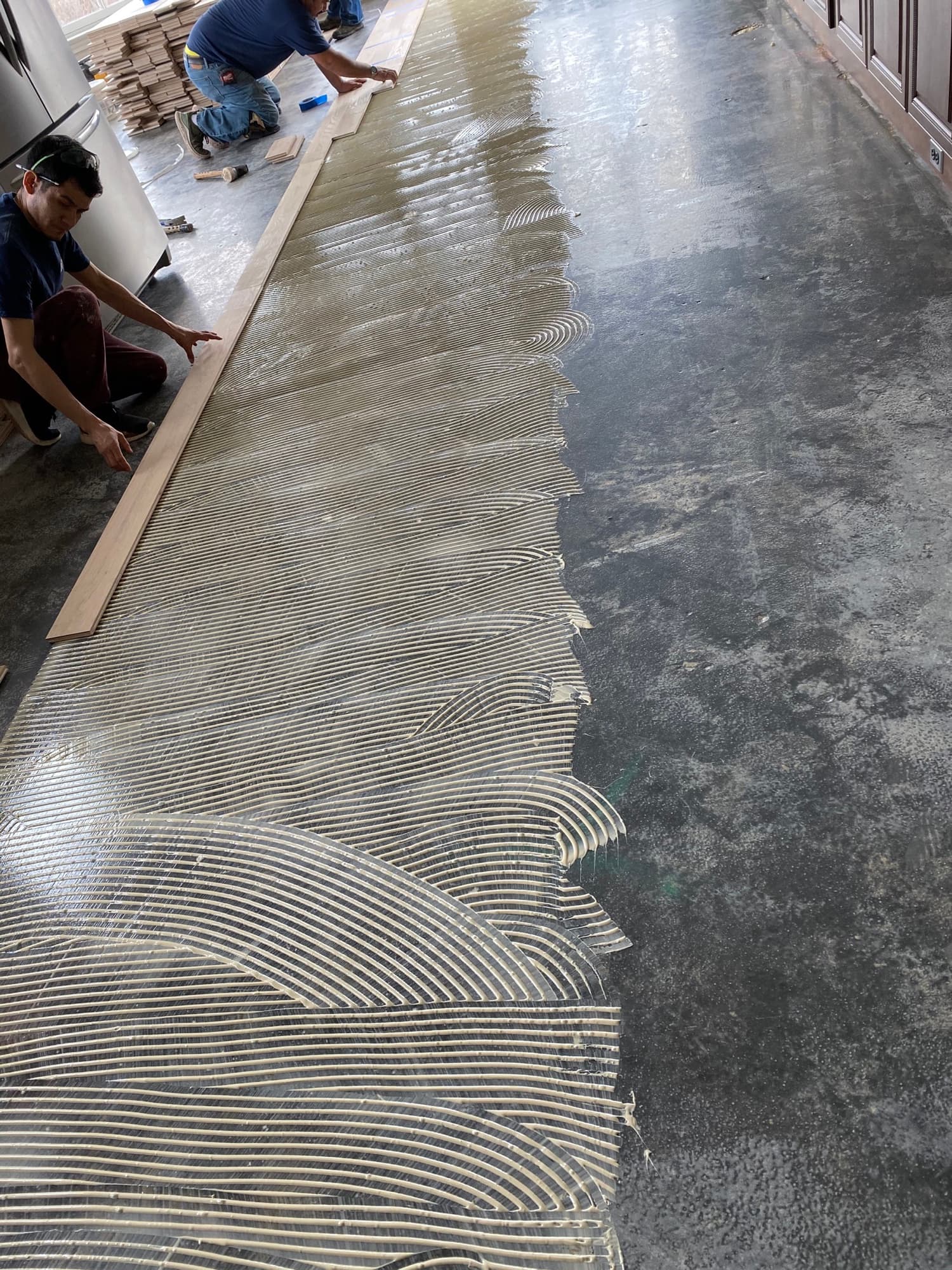
Most post-2000 construction in western Wake County sits on slab. Solid hardwood cannot go over concrete. Engineered hardwood via glue-down is the correct call. We apply a roll-on moisture barrier before any adhesive goes down, on every job.
Crawlspace moisture in Johnston County and older Raleigh neighborhoods.
Crawlspace homes in Clayton, Smithfield, and eastern Wake County are the highest-risk installs for moisture-related failure. We test from above and document moisture content of both the subfloor and the wood before anything gets fastened. Vented crawlspaces in NC summers can push humidity well above acceptable installation limits.
Subfloor leveling issues in production homes.
Tract homes in Clayton, Garner, and the outer Triangle suburbs were built fast. We regularly find subfloors with high and low spots that exceed the 3/16 inch over 10 feet tolerance. We flatten before we install. A floor laid over an unlevel subfloor will telegraph every hump and hollow through the finished surface.
Squeak problems in older Raleigh homes.
Homes built in the 1970s through 1990s often have OSB subfloors with loose fasteners and subfloor panels that have lost their glue bond. Before installation we walk every inch of the subfloor, identify movement, and secure it. Squeaks after a new floor is installed are almost always a subfloor problem that predated the installation.
Wide-plank white oak over crawlspaces.
Wide plank (5 inches and above) moves more across its width than narrow strip flooring. Installed over a crawlspace without proper moisture control, wide-plank white oak can cup or gap seasonally. We factor in your home's foundation, the crawlspace condition, and the plank width when determining whether solid or engineered is the right choice.
Engineered hardwood over concrete in newer construction.
New construction in Cary, Apex, and Holly Springs frequently has polished concrete or LVP over slab that homeowners want to upgrade. Engineered hardwood glued directly to a properly prepared concrete slab is the right approach. We test the slab's moisture emission rate, not just its surface moisture, before any material is ordered.
Making the Right Choice
Solid vs. Engineered Hardwood in North Carolina Homes
This question comes up on almost every installation consult. The answer depends on your foundation type, subfloor, lifestyle, and plank width preference. Both are real hardwood. Both can be site-finished to the same result. The difference is in how they handle moisture and where they can be installed.
North Carolina's humidity adds a variable most installation guides ignore. With summer humidity regularly pushing indoor RH above 60% in homes without tight climate control, dimensional movement matters. Wider planks move more. Engineered's cross-ply construction resists that movement better than solid, which is why we often recommend engineered for wide-plank applications over any subfloor type.
We walk through this choice at every assessment. By the time we leave, you will know exactly what is right for your home and why.
Solid hardwood
Can only be installed on raised wood subfloors. Cannot go over concrete or below grade. Ideal for traditional construction in Johnston County and older Raleigh neighborhoods. Can be sanded and refinished 6 to 10 times over its lifetime.
Engineered hardwood
Can be installed over concrete via glue-down, works over radiant heat, and is appropriate for slab construction in Cary, Apex, and Holly Springs. More dimensionally stable for wide-plank applications. Refinishability depends on wear layer thickness.
Wide plank (5 inches and above)
Wide plank is the most popular request in the Triangle right now. For most wide-plank applications, especially over slab or in homes without tight climate control, engineered is the more stable choice. The full <Link href="/blog/engineered-vs-solid-hardwood-flooring-nc" className="text-gold hover:underline font-bold">engineered vs solid breakdown</Link> explains why. We evaluate subfloor, foundation, and climate control at the assessment before making a recommendation.
Humidity and acclimation
Both solid and engineered must acclimate to your home's actual temperature and humidity conditions before installation, not just the day of install, but the full range your home sees across seasons. We build acclimation time into every project timeline.
Site-finishing applies to both
Solid and engineered hardwood can both be site-finished. The sanding, staining, and finish process is identical. You get the same seamless, custom result regardless of which type is right for your subfloor.
Material Selection
Wood Species We Install
Not sure which species is right for your home? We walk you through the options during your consultation. White oak vs. red oak guide is a good place to start.
White Oak
Red Oak
Hickory
Hard Maple
Walnut
Brazilian Cherry
Ash
Heart Pine
Finish Options
Finish Systems We Use
One finish system throughout the entire home. Your choice depends on your lifestyle, traffic, and the look you want. Full finish comparison with cure times, durability, repairability, and sheen options.
Hardwax Oil
A catalyzed hardwax oil with added hardener that penetrates the wood fibers and cures inside them rather than forming a film on top. Feels like wood underfoot, not wood under glass. Natural matte to very low sheen. Zero VOC. Spot-repairable without resanding. Available as Rubio Monocoat or Natura OneCoat.
Full cure: 5 days
Bona Traffic HD
Commercial-grade water-based polyurethane. Highest durability of any water-based finish we carry. Fastest cure at 3 days. Available in Raw, Extra Matte, Satin, Semi-Gloss, and Gloss. Best when fastest cure or widest sheen range is the priority.
Full cure: 3 days
Bona Mega One
Residential-grade water-based polyurethane and the best one-component finish we have used. Our value recommendation for bedrooms, formal rooms, and budget-focused projects. Available Matte through Semi-Gloss. Where wear is highest we recommend Traffic HD for the longest time between recoats.
Full cure: 5 days
Detailed breakdown of cure times, durability, repairability, VOC, and which finish fits which household.
Full Finish Comparison →How We Work
Our Installation Process
In-Home Consultation
We measure your space, evaluate the subfloor, walk through wood species and finish options, and provide a detailed written estimate with no surprises. Every recommendation follows NWFA installation standards.
Deposit and Material Ordering
Once you move forward we collect a deposit and order your materials. Our primary oak supplier is Ten Oaks, a premium hardwood supplier. No big-box store materials.
Acclimation
Your hardwood acclimates to your home's temperature and humidity before installation begins. We offer acclimation in our climate-controlled warehouse in Clayton or on-site at your home.
Moisture Testing and Documentation
We test and document subfloor and hardwood moisture content using a Tramex MEX5 (pinless) and Delmhorst Total Check (pinned). We then apply a Wakol PU280 or Bona R540 roll-on moisture barrier, a significant upgrade over rosin paper.
Installation
We install using Primatech and Bostitch cleat nailers exclusively, no staplers, which can split the tongue and cause squeaks. Glue-down work uses Bona Quantum R851 or Quantum Flow adhesive.
Sanding
We sand with a Lagler Hummel, Bona PowerDrive, and Lagler Flip paired with Festool HEPA vacuums for a virtually dustless result. We work from coarser to finer grits for a perfectly smooth, flat surface.
Water Popping Before Color and Color Sampling
On every floor that gets color, we mist the bare wood before the color goes on. Water popping before color opens the grain at the cellular level for deeper, more even color absorption. We then apply sample colors directly on your floor so you can see the result on your specific species in your specific lighting.
Stain Application
We apply your chosen stain, or custom blend a color on-site, to the water-popped surface and allow it to dry completely before moving to the sealer coat.
Finish Application
We apply a sealer coat first, then multiple topcoats of your chosen finish system, sanding lightly between coats. Finish choice is discussed at the consultation: hardwax oil (Rubio Monocoat or Natura OneCoat), Bona Traffic HD, or Bona Mega One.
Final Inspection and Walkthrough
We walk you through the finished floor and do not leave until you are completely satisfied.
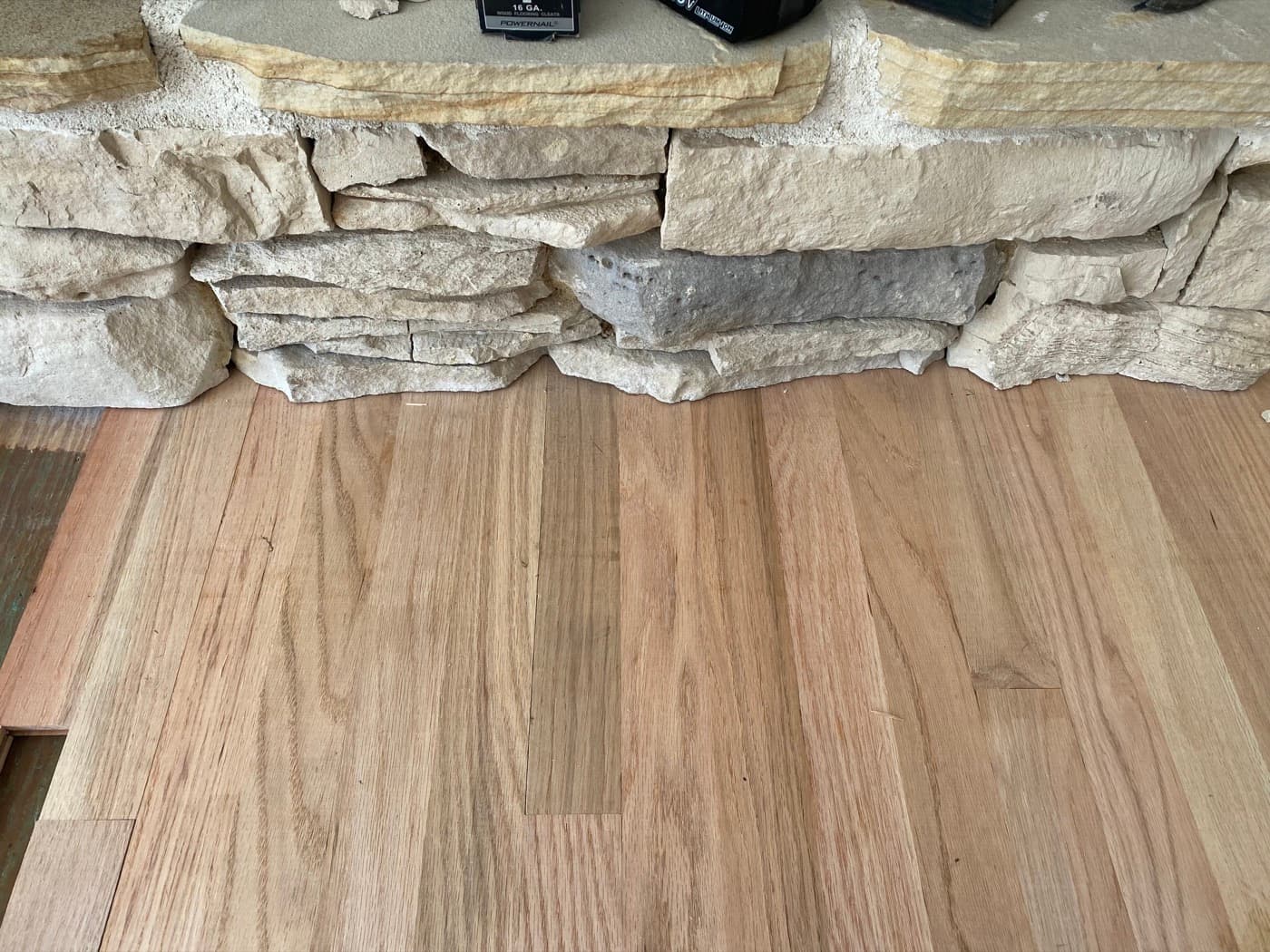
Why water popping before color matters on every installation
Misting bare wood before staining opens the grain at the cellular level, allowing stain to penetrate more deeply and evenly. The result is richer color with fewer lap marks, especially critical on white oak. Read the full water-popping guide to understand exactly what happens on red oak vs. white oak and why it affects the finished result.
What Goes Wrong
Why Hardwood Installation Fails
Most hardwood floor failures are preventable. They happen when steps are skipped, corners are cut, or installers lack the equipment to do the job correctly. Here is what causes them.
Skipped acclimation.
Wood installed without proper acclimation to the home's temperature and humidity will expand or contract after installation, causing gaps in dry conditions or buckling in humid ones. We build acclimation into every project and offer warehouse acclimation in our climate-controlled Clayton facility when the home is not yet conditioned.
No moisture testing.
This is the most common mistake we see: eyeballing it, or taking a single surface reading with one meter. We use two calibrated meters on every job, pinless for area scanning and pin for depth, and document every reading before any wood goes down. If the numbers are wrong, we stop.
Unlevel or unsecured subfloor.
A subfloor with high and low spots produces hollow spots, edge lift, and visible unevenness in the finished floor. A subfloor with loose fasteners produces squeaks. We walk and probe every subfloor, secure movement, and flatten high spots before installation begins.
Staple fastening.
Staples are faster and cheaper than cleats. They are also more likely to split the tongue, which creates movement between boards and eventual squeaking. We use Primatech and Bostitch cleat nailers exclusively. No staplers.
Wrong or missing moisture barrier.
Rosin paper is the common standard. We apply a roll-on moisture barrier, Wakol PU280 or Bona R540, on every installation: solid hardwood, engineered hardwood, LVP, and laminate. On glue-down and concrete applications, we also test moisture emission rates before adhesive goes down. The barrier is the last line of defense against what is coming up from below.
Rushing stain and finish application.
Finish applied over wet stain, or second coats applied before the first is fully dry, fail. Bubbling, peeling, and delamination are all signs of schedule shortcuts. We follow manufacturer-specified dry times on every coat and do not move to the next step until conditions are right.
Craftsmanship
Hand Scraped Bevels on Rift and Quartered White Oak
Watch our team hand scrape the bevels on a distressed rift and quartered white oak floor, adding an organic, artisan edge to each board that machines simply cannot replicate. This technique gives the floor a more natural, lived-in character while honoring the way floors were crafted before the age of automation.
Rift and quartered white oak is the most dimensionally stable cut available. Combined with hand scraped bevels and a distressed finish, the result is a floor that looks like it has always been there and will be there for generations.
Hand scraped bevels on rift and quartered white oak. Wendell, NC. This is the kind of detail work that separates a craftsman from a contractor.
Species Spotlight
White Oak: The Most Popular Floor in the Triangle Right Now
White oak has overtaken red oak as the most requested species in the Triangle. Its tight, consistent grain, natural warm tone, and exceptional dimensional stability make it one of the most versatile floors available. It accepts stain beautifully and holds up to the humidity cycles that affect North Carolina homes better than most domestic species. Read the full white oak vs. red oak comparison for grain, hardness, stain behavior, and which is right for your home.
What homeowners do not always know is that white oak is one of the most unforgiving species to sand and stain correctly. Its open grain structure means stain absorbs unevenly without proper preparation. Water popping before color is not optional on white oak. It is the step that separates a flat, blotchy result from a deep, even color that looks the same in every corner of the room. We use it on every white oak floor that receives stain.
The Bona PowerDrive planetary sander is a genuine advantage on white oak. Because the heads rotate simultaneously in different directions, it removes material evenly across both the soft and hard grain. The result is a flatter surface with less material removed per pass, which matters on wide plank white oak where even minor dish-out is visible under raking light.
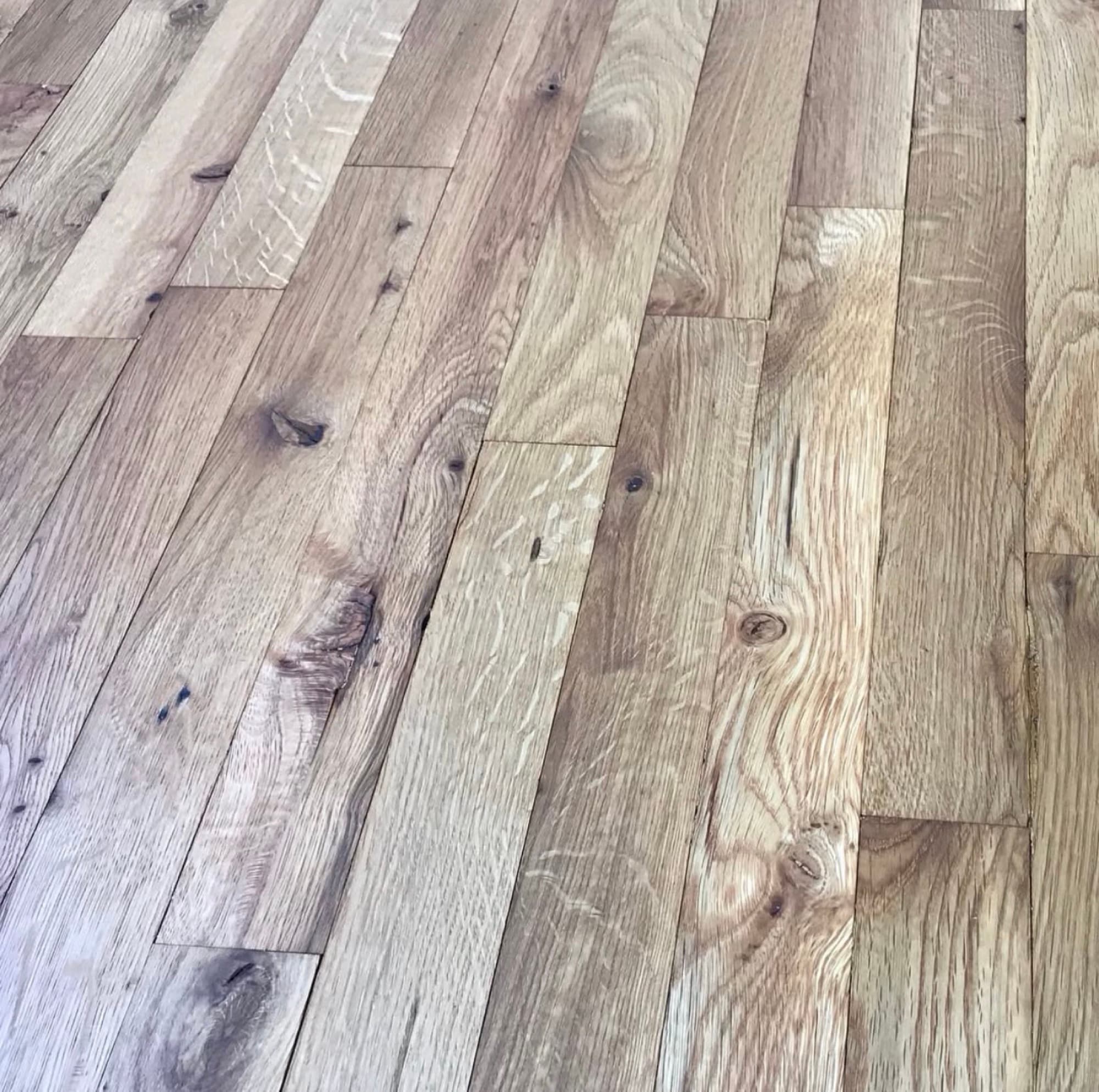
Janka hardness: 1360.
White oak registers 1360 on the Janka hardness scale, above red oak at 1290. It handles pets, furniture, and high-traffic areas without the denting issues that affect lower-hardness species.
Water popping before color is not optional.
White oak's open grain absorbs stain differently depending on how the surface is prepared. We water pop every white oak floor before color goes on to open the grain uniformly. This is the step we consider most important.
Wide plank specialty.
Wide plank white oak (5 inches and above) is one of the most popular requests in the Triangle right now. Wider planks show more character and grain variation, and they demand a flatter sand to avoid visible dish-out between boards.
Rift and quartered cuts.
Rift and quartered white oak offers the most linear, consistent grain pattern available. It is the most dimensionally stable cut, with minimal seasonal expansion, and shows the ray fleck pattern that makes white oak immediately recognizable.
Complete the Project
Staircase Remodeling Integrated with Every Installation
We do not stop at the base of the stairs. We do not. Staircase remodeling is one of our core services and we integrate it with every new floor installation that has an adjacent staircase.
We convert carpeted stairs to hardwood treads matched to your new floor, replace or refinish newel posts and handrails, and handle all the transition details that make a staircase feel intentional rather than added on. The stain and finish are applied in the same sequence as your floor so everything reads as one cohesive project.
Staircase Remodeling →Carpet removal and tread replacement
Treads matched to your new hardwood species and stain
Newel post and handrail refinishing or replacement
Baluster upgrades
Flush transitions and threshold work throughout
Stain and finish applied in the same sequence as your floor
No Pressure. Straight Answers.
What's Included in a Floor Assessment?
Our in-home consultation is a technical evaluation, not a sales call. We come prepared to give you real answers about what your floor needs and what it will cost. By the time we leave, you have a written estimate and enough information to make a confident decision.
Subfloor flatness check and structural walk-through
Two-meter moisture testing, documented in writing
Species recommendation based on your foundation and lifestyle
Solid vs. engineered guidance for your specific subfloor
Plank-width consultation with dimensional stability context
Staircase integration planning if applicable
Finish system guidance (hardwax oil, Traffic HD, or Mega One)
Stain sampling on your actual wood before you commit
Transition and threshold planning room by room
Written estimate, full scope, no surprises
Reputation
What Our Customers Say
“12th And Oak Floor Co did the most amazing job on both installation of new hardwood floors and refinishing existing hardwood floors. Izral provided us with a detailed estimate and a thorough explanation of exactly how the job would be done.”
Rick Chapman
“We are SO HAPPY with our floors! I talked with 4 other contractors and no one was as helpful, patient, and knowledgeable as Izral. He walked us through every option and made the whole process easy. The finished result is stunning.”
Jennifer Franz
“Izral is a master at his craft and took time to explain all of the options in detail. He and his team did a fantastic job with everything going exactly as planned, including daily cleanups of dust and debris.”
Bill Gentry
Common Questions
Frequently Asked Questions
The timeline depends on the size of the project and the finish system you choose. A typical installation for an average-sized home takes 5 to 10 days from installation through final finish coat. We will give you a specific timeline during your consultation.
Hardwood floor installation in the Triangle area typically ranges from $15 to $25 per square foot installed and finished, depending on the wood species, finish system, and subfloor conditions. We provide detailed written estimates with no hidden fees.
It depends on your subfloor and foundation type. Solid hardwood cannot be installed over concrete or below grade and requires a raised wood subfloor. Engineered hardwood can go over concrete via glue-down, works over radiant heat, and is more dimensionally stable for wide-plank applications. Both are available in site-finished options. We evaluate your specific subfloor and foundation type during the in-home consultation and recommend accordingly.
Yes. We install both unfinished and prefinished hardwood. However, our specialty and preferred method is site-finished hardwood, which delivers a seamless surface, unlimited color options, and a finish bond that prefinished flooring cannot match. We are happy to discuss both options during your consultation.
Yes. Matching existing hardwood is one of our specialties. We assess your current species, grain pattern, and stain color and do everything we can to achieve a seamless blend. Results depend on the age and condition of your existing floors, which we will evaluate during the consultation.
It depends on the finish system. Water-based finishes are dry to the touch in 2 to 3 hours and ready for socks after 4 hours. Bona Traffic HD reaches full cure in 3 days. Hardwax oil systems (Rubio Monocoat and Natura OneCoat) and Bona Mega One reach full cure in 5 days. We will walk you through the specific cure schedule for your chosen finish before we start.
Almost always, yes. The subfloor must be structurally sound, flat to within 3/16 inch over 10 feet, dry, and within acceptable moisture limits before any hardwood goes down. We evaluate the subfloor during the in-home consultation and identify any issues that need correction first. Common prep work includes securing loose plywood, flattening high spots, filling low spots, and applying a moisture barrier. Skipping subfloor prep is one of the most common reasons floors fail prematurely.
We use a Tramex MEX5 pinless moisture meter and a Delmhorst Total Check pin meter on every job: both meters, every subfloor. Pinless meters give us a broad area scan; the pin meter gives us precise depth readings. We also check flatness with a straight edge and assess the structural integrity of the subfloor by walking it, looking for soft spots, bounce, and fastener movement. All findings are documented before work begins.
Yes, we are fully insured. We hold Bona Certified Craftsman status, one of the highest professional credentials in the hardwood flooring industry, and are active members of the National Wood Flooring Association (NWFA).
12th And Oak Floor Co. is a Bona Certified Craftsman with 24 years of hardwood floor installation experience serving Clayton, Raleigh, Garner, Cary, Apex, Holly Springs, Wake Forest, and the Triangle. We have installed nearly 2 million square feet of hardwood since 2002 and carry a 5.0 Google rating from 57 verified reviews. Every installation is backed by a five-year warranty. Call 984-400-4OAK (4625) or schedule your in-home consultation online.
Our Work
Recent Installation Projects
View All Projects →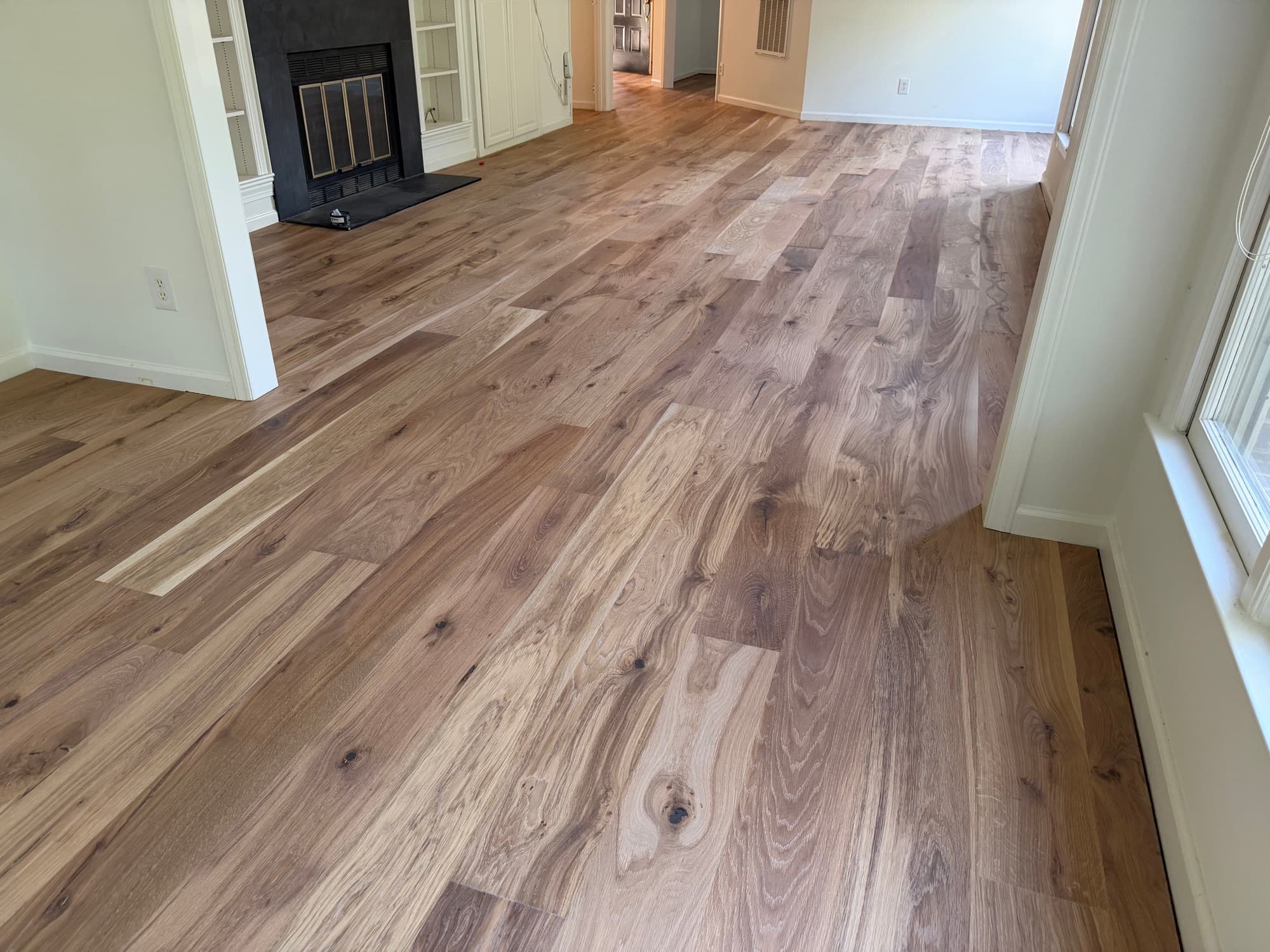
Hardwood Floor Installation · Off Glenwood Avenue, Downtown Raleigh
Character European White Oak Installation Off Glenwood Avenue in Downtown Raleigh, NC
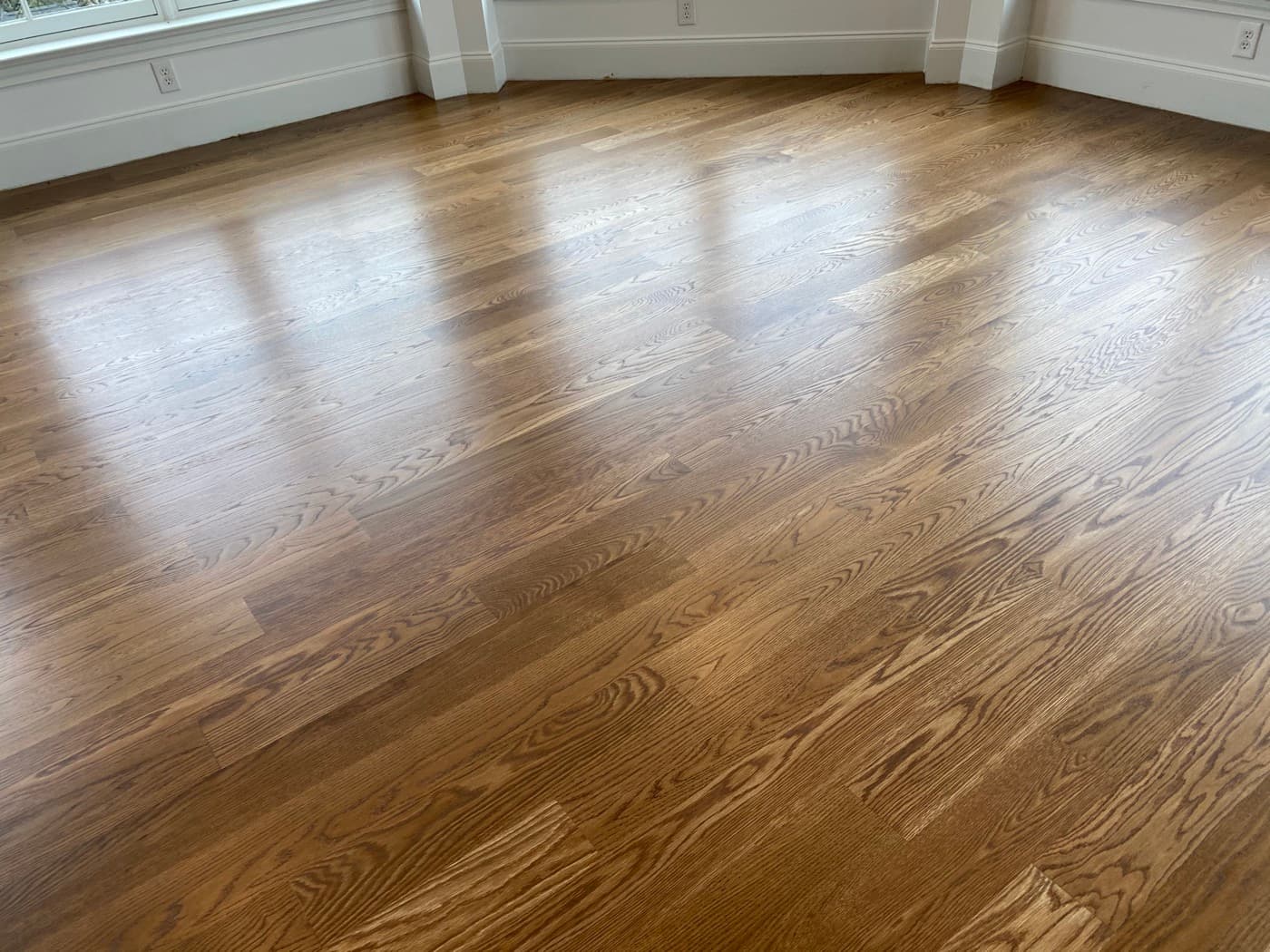
Engineered Hardwood Floor Installation · Bloomsbury Estates
Engineered White Oak Floor Installation in Bloomsbury Estates, Raleigh NC
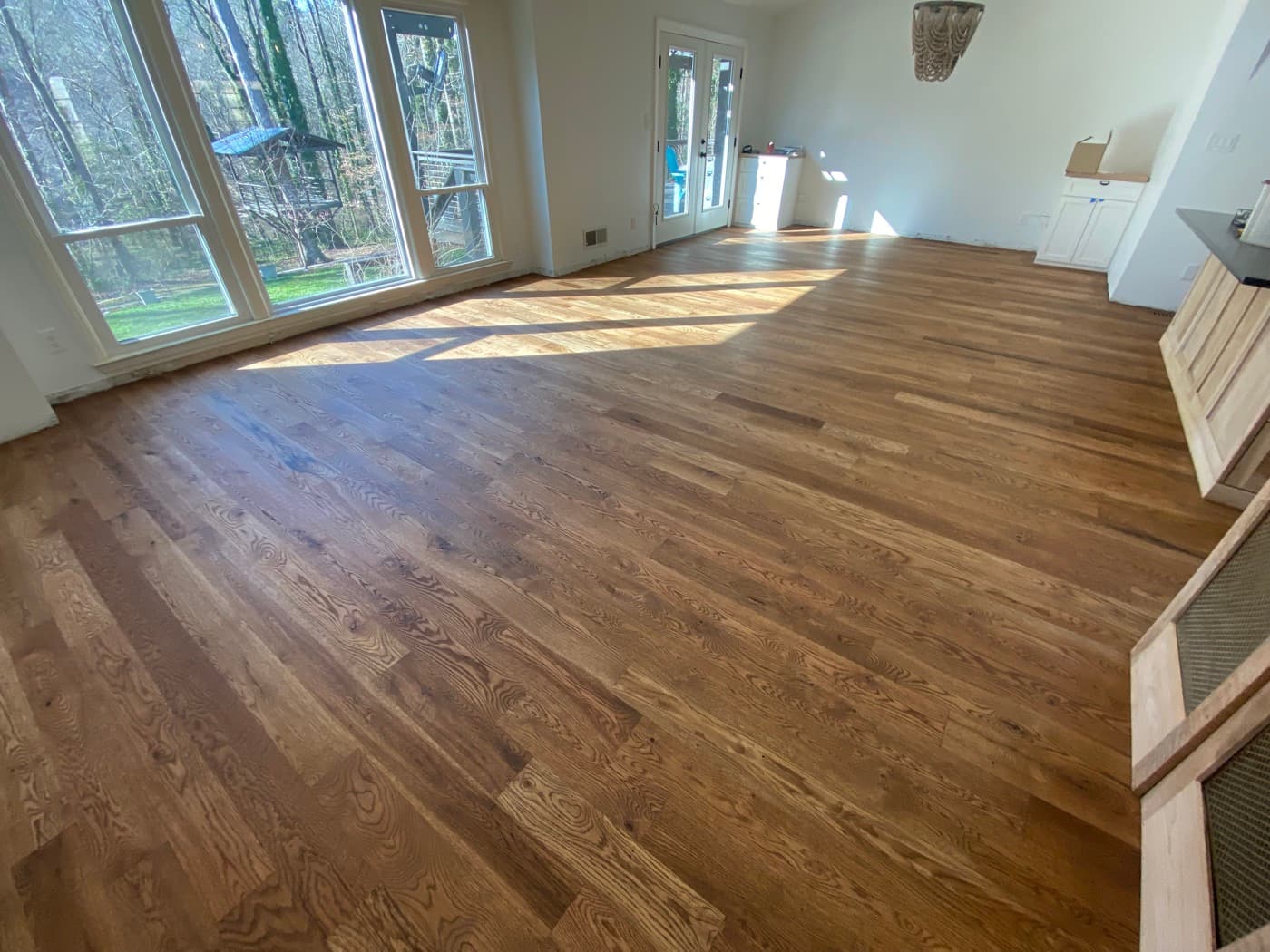
Engineered Hardwood Installation with Pallmann Magic Oil · Oak Park
5" Engineered White Oak with Custom Pallmann Magic Oil Blend in Oak Park, Raleigh
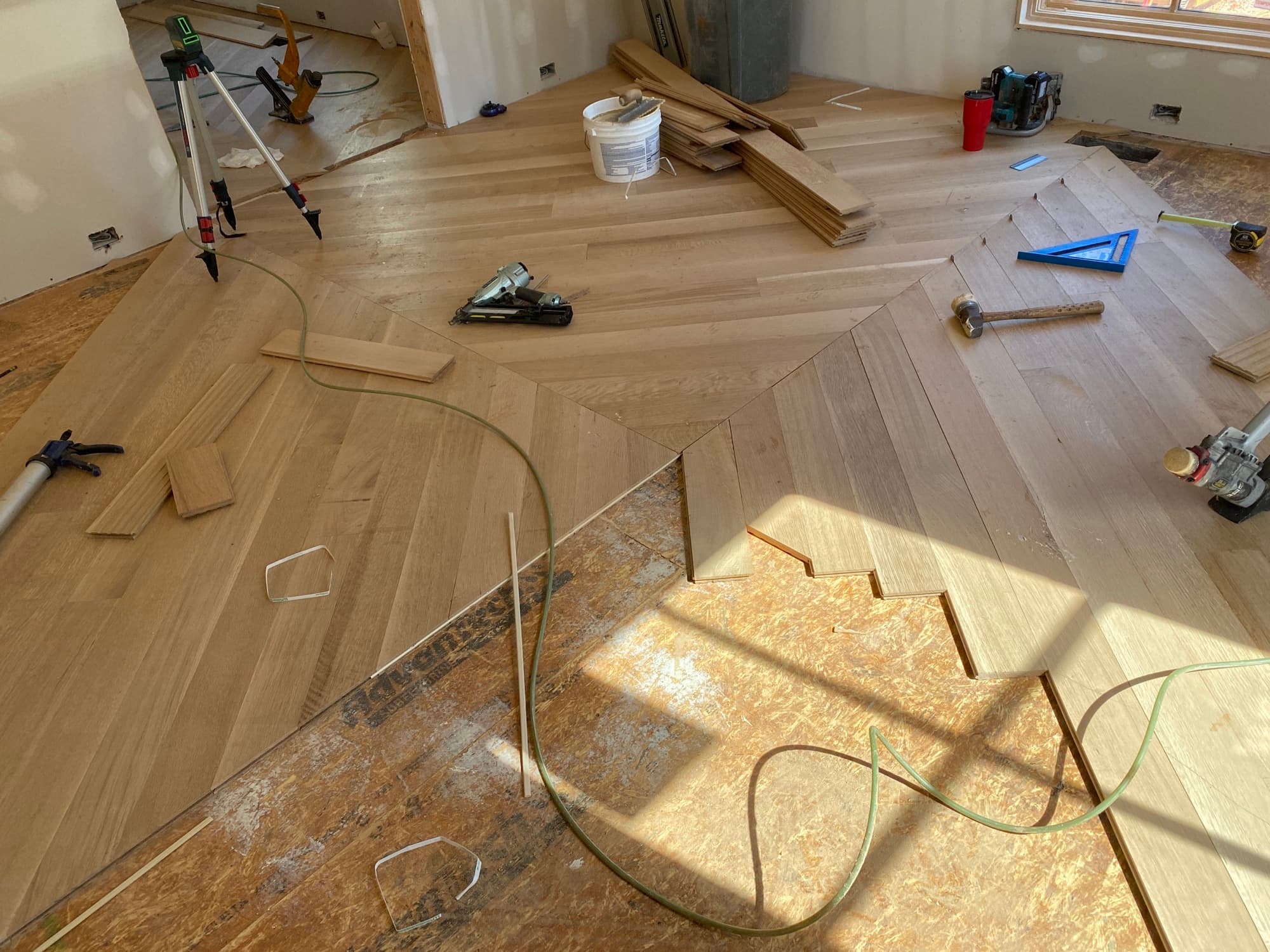
Ready to Get Started?
Start With aFree Estimate
Serving Clayton, Garner, Raleigh, Cary, and communities throughout Johnston, Wake, and Durham Counties. We respond within one business day.
Ready to pick a time? Book your in-home assessment online →
After you request an assessment, we review your project details, confirm your location, and schedule an in-home visit. You will receive a written proposal with the scope, products, timeline, and warranty clearly explained.
Want to see our work first? Browse the portfolio →
Continue Exploring
Related Services
Staircase Remodeling→
Convert carpeted stairs to hardwood, match your new floors, and upgrade handrails and newel posts. Integrated with every installation project we do.
Hardwood Floor Refinishing→
Sand, stain, and refinish your existing hardwood back to like-new condition. Water popping on every floor that gets color. Five-year warranty.
LVP Flooring Installation→
Luxury vinyl plank for areas where hardwood is not practical. Waterproof, durable, and moisture-tested on every job.
In-Depth Guides
Site-Finished vs. Pre-Finished Hardwood Floors
Why site-finished floors look better, bond better, and give you more options than anything that comes finished from the factory.
White Oak vs. Red Oak Hardwood Floors
Grain, stain behavior, hardness, wide plank availability, and which species is right for your Triangle home.
Bona Traffic HD vs. Rubio Monocoat: Full Finish Comparison
Cure times, durability, repairability, VOC, sheen options, and which finish fits which household.
LVP vs. Hardwood Flooring in North Carolina
An honest comparison from a contractor who installs both. Where LVP wins, where hardwood wins, and how to decide.
Installation by City
Where We Work
Serving the Triangle Since 2002
Based in Clayton, NC. We travel throughout Johnston, Wake, and Durham Counties. Call to confirm your specific location.
Johnston County
Home Base- Clayton
- Garner
- Smithfield
- Selma
- Four Oaks
- Benson
- Kenly
- Princeton
Wake County
- Raleigh
- Garner
- Cary
- Apex
- Fuquay-Varina
- Holly Springs
- Wake Forest
- Knightdale
- Wendell
- Zebulon
Durham and Orange Counties
- Durham
- Chapel Hill
- Hillsborough
Don't see your city? Call us. We consider jobs outside these areas on a case-by-case basis, particularly for larger projects.
984-400-4OAK (4625)Want to see hardwood samples, stain colors, and finish options in person? Visit our Clayton showroom by appointment.
Call to Book →Get Started
Ready to Install Your Dream Floor?
Contact 12th And Oak Floor Co. today to schedule your in-home consultation. No pressure, no surprises, just honest expertise and a floor you will love for decades.
Installation pricing depends on species, width, and layout. Engineered and solid hardwood are priced separately. Written estimate provided before any work begins.
After you request an assessment, we review your project details, confirm your location, and schedule an in-home visit. You will receive a written proposal with the scope, products, timeline, and warranty clearly explained.
113 State Ave #103, Clayton, NC 27520 · Mon-Fri 9am-4pm · By appointment is best